What Causes Voids Under Concrete?
The empty space under a slab — the void — is what settlement really means. Here's how voids form under concrete in the Inland Northwest, how to detect them, and why they need to be filled, not just lifted.
Free On-Site Estimate · Serving Spokane & the Inland Northwest
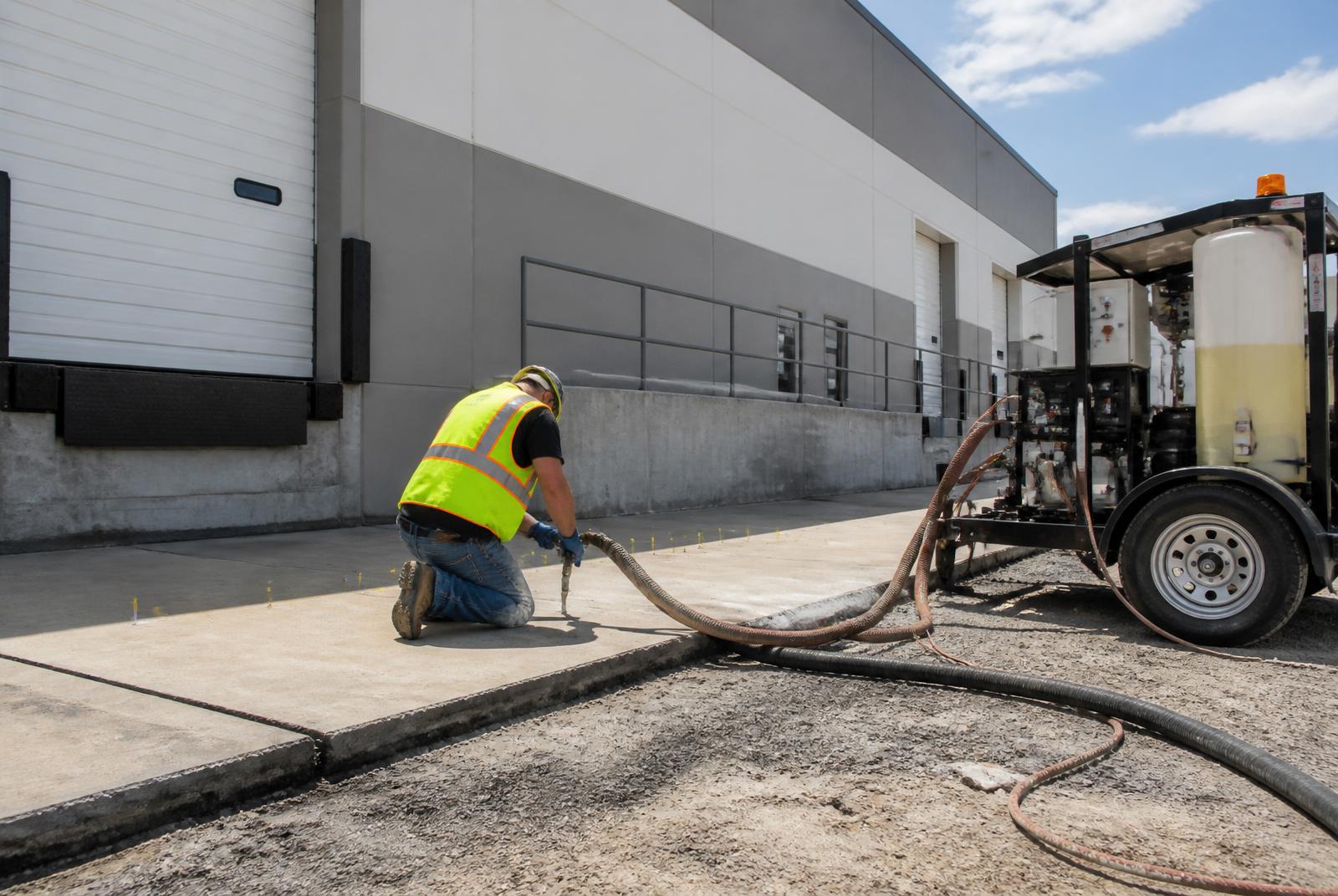
Problem overview
What's actually happening.
A slab that's dropping is following a void. The void is the empty or loose space that used to be dense, packed soil supporting the concrete. Fix the void and you fix the slab; ignore it and no lift will hold.
In Spokane, voids form for a small number of predictable reasons — water washing soil out, fill compacting under weight, and organic material like tree roots decomposing. Each leaves a different signature.
Understanding how voids form helps you evaluate any repair proposal. If the fix isn't filling the void, it isn't a fix.
For the underlying service, see concrete leveling. Serving Spokane, WA and the surrounding Inland Northwest. Ready to skip ahead? Request a free estimate.
Signs to watch for
How this problem shows up.
Hollow sound when tapped on the slab
The classic void indicator — the concrete is spanning air.
Rocking or tipping panels
The slab has lost contact with the soil below at one corner or edge.
Visible dip or drop in the slab surface
The concrete is settling into the void.
Cracks running from an unsupported edge inward
The slab is flexing over an unsupported span.
Mud or soil migrating out of joints
Water is moving under the slab and carrying soil with it.
Water pooling in a new low area
The slope is following the void.
Common causes
Why it happens in the Inland Northwest.
Spokane's freeze/thaw cycles, clay-and-silt soils, and heavy seasonal runoff produce a fairly predictable set of root causes.
Water erosion of the subgrade
The most common cause. Downspouts, irrigation, sprinklers, or poor grading flush soil out from under the slab.
Fill compaction over time
Backfill placed at construction compresses under its own weight and the load above.
Freeze/thaw cycling
Wet subgrade expands and contracts, opening space between soil particles.
Organic decomposition
Tree roots, buried wood forms, or old landscape debris rot and leave voids.
Utility trench settlement
Trenches for water, gas, sewer, and electric settle for years after backfill and leave voids under slabs above them.
Clay shrinkage in dry weather
Clay soils common in the Inland Northwest pull away from slabs in dry summers, leaving air spaces.
How to determine severity
Read your slab like a pro.
A quick self-triage. When in doubt, request a free on-site walkthrough.
- Isolated hollow spot, no visible drop yet: minor. Fix now while it's small.
- Rocking panel or hollow across a wider area: moderate — the void is meaningful.
- Slab dropping into the void with cracks radiating: significant.
- Water actively moving through the void: high priority. Erosion is compounding.
- Multiple slabs with linked voids: often points to a bigger drainage or fill issue that needs a broader fix.
Not sure how bad it is?
Get a free walkthrough before it gets worse.
We'll measure the drop, check for voids, evaluate the drainage, and give you an honest recommendation — including whether it's a leveling job or something else.
Why waiting makes it worse
Settlement doesn't fix itself.
Every cause listed above keeps working whether or not the slab is addressed.
- Voids grow — they don't heal.
- Water continues to migrate through unfilled voids and enlarges them.
- Slabs crack over unsupported voids and lose their ability to be lifted intact.
- Adjacent slabs and structures start settling into linked void networks.
- Repair cost scales with void size — small voids are inexpensive; large ones require more material.
Repair options
What are your choices?
An honest comparison — the right fix depends on the slab, the cause, and the goal.
Polyurethane foam injection
Foam expands to fill the void completely and stabilizes surrounding soil. Also lifts the slab back to level as part of the same process.
Mudjacking (cement slurry)
Fills voids with heavy slurry. Works, but adds significant weight to already-weak subgrade.
Void grouting without lift
Occasionally appropriate when the slab is still at grade but the subgrade needs stabilizing.
Excavation and re-compaction
For very large voids or unstable fill situations. Rare on residential slabs.
Why polyurethane foam usually wins
The best fit for the vast majority of Spokane slabs.
- Cures in about 15 minutes — you can drive or walk on the slab the same day.
- Closed-cell foam doesn't wash out or absorb water like sand or slurry-based methods.
- Injection holes are dime-sized, not the golf-ball ports left by mudjacking.
- Lightweight — adds roughly 4 lbs per cubic foot vs. 100+ lbs for mud slurry, so it won't re-settle weak soil.
- Stabilizes the underlying soil at the same time it lifts the slab.
For a full comparison, see polyurethane foam vs. mudjacking in the Learning Center.
When replacement may be necessary
The honest cases where leveling isn't the right call.
- The slab is crumbling, spalling apart, or shattered with structural cracks — there's no solid piece left to lift.
- The concrete is very thin (below ~3 inches) and would crack under the lift pressure.
- You're changing the layout — widening a driveway, moving a patio, adding a new pour.
- Reinforcement is severely rusted and the slab is delaminating.
More detail in concrete leveling vs. replacement.
Frequently asked questions
Straight answers from Spokane homeowners.
- How do you find a void under a slab?
- Tapping the slab reveals hollow sections; visual inspection catches drops and cracks; probes and cameras confirm size when needed.
- Can you fill a void without lifting the slab?
- Yes — sometimes appropriate when the slab is still at grade but the subgrade needs support. Usually done as part of a full leveling.
- How does foam actually fill a void?
- Injected as a liquid, foam expands rapidly to fill any connected space, then hardens. It occupies the void completely and bonds with surrounding soil.
- Will foam leak out somewhere?
- Almost never — the expansion is controlled and the technician monitors slab movement during injection to know when the void is full.
- How long does the fill last?
- Indefinitely. Polyurethane foam doesn't compress, wash out, or degrade.
- Does mudjacking fill voids as well as foam?
- It fills them, but the material is heavier and can wash out through the same water pathway that created the void.
- Is a void under my slab dangerous?
- It's a problem, not an emergency. Slabs over voids can crack under load — a car parked on an unsupported driveway is where you'd see it worst.
- Do you evaluate voids in the free estimate?
- Yes — we tap, probe, and photograph as part of every walkthrough.
Related services
Explore the services that solve this problem.
Related problems
Other homeowner questions we hear.
From the Learning Center
Related reading before you request an estimate.
Free estimate — no obligation
Fix it before the next wet season.
Settlement compounds. Every rainstorm and freeze/thaw cycle makes the void bigger. Get an honest walkthrough now and know exactly what your options are.
Lift it — don't replace it.
Have questions about your concrete? Need advice? Want a free estimate? We're here to help. Concrete leveling saves the slab you already have, at a fraction of the cost of replacement.
- Often less costly and less disruptive than tear-out and replacement
- Repair before replacement when appropriate
- Modern concrete lifting methods
- Clear recommendations — no pressure, no upsells
Free Estimates · Spokane-Focused Service · Clear Recommendations