Concrete leveling vs. concrete replacement.
If your driveway, sidewalk, or patio has settled, you have two real choices: lift the slab back to grade or tear it out and pour new. Here's how they compare for a Spokane home — cost, time, lifespan, and the honest cases where replacement is the smarter buy.
Free On-Site Estimate · Serving Spokane & the Inland Northwest
Overview
What we're actually comparing.
Most homeowners in Spokane assume settled concrete has to be ripped out and repoured. In reality, the vast majority of residential slabs — driveways, sidewalks, patios, garage floors — are structurally sound. What failed is the soil underneath, not the concrete itself. That's what leveling is designed for.
But leveling isn't always the answer. Slabs with structural cracks, spalling, or reinforcement damage genuinely need replacement. This page walks through the cost, disruption, longevity, and Spokane-specific considerations of both options so you can pick the one that actually fits your situation.
For the underlying service, see concrete leveling. Serving Spokane, WA and the surrounding Inland Northwest. Ready to skip to a real recommendation? Request a free estimate.
The two options
A plain-English look at each method.
Concrete Leveling
Lift the existing slab back to grade by filling voids beneath it.
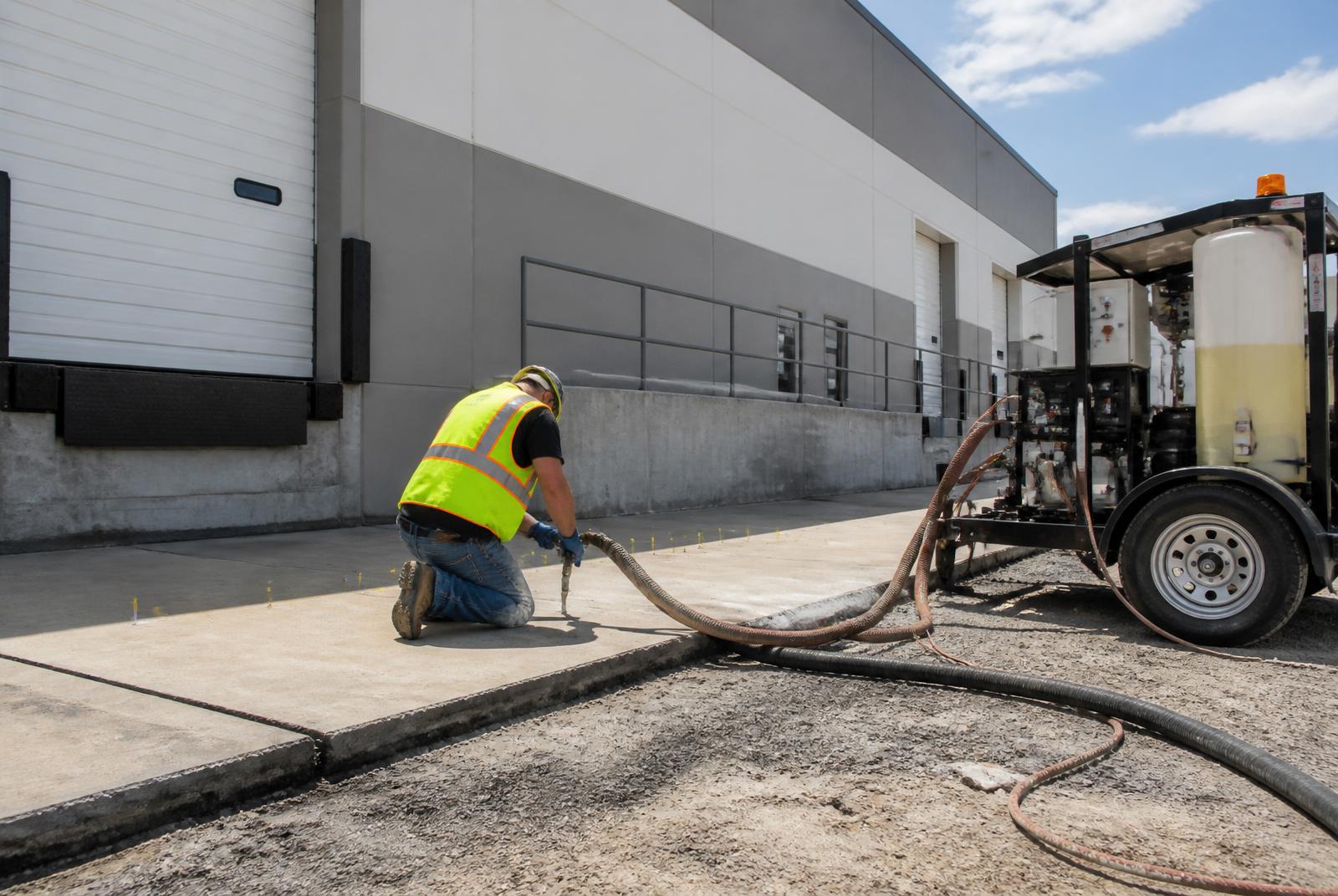
Polyurethane foam is injected through dime-sized ports drilled through the slab. The expanding foam fills voids in the underlying soil, then continues to expand until it lifts the concrete back to level.
The existing slab stays. The soil is stabilized as a byproduct. In Spokane, most residential jobs are done in a few hours and you can walk or drive on the slab within about 15 minutes of the final port being filled.
Concrete Replacement
Demolish the slab, re-grade the base, and pour new concrete.
The old slab is broken up and hauled off. The exposed subgrade is re-compacted and, in most cases, a new base of crushed rock is placed and compacted before forms and rebar go in and new concrete is poured.
New concrete has to cure. Vehicle traffic is typically kept off for at least a week and light foot traffic for a couple of days. Full strength takes 28 days — a real factor if you're replacing a driveway you actually use.
Pros and cons
Honest tradeoffs for each option.
Concrete Leveling
Pros
- Roughly a third of the cost of replacement in most Spokane jobs.
- Same-day return to service — walk on it in minutes, drive on it in hours.
- No landscaping, sod, or irrigation damage from tear-out.
- Stabilizes the soil at the same time it lifts the slab.
- Doesn't reset the concrete's cosmetic age against the rest of your yard.
Cons
- Doesn't fix cosmetic cracks or spalled surfaces — it lifts, it doesn't resurface.
- Won't help slabs that are structurally shot or too thin to lift.
- Leaves dime-sized patched ports visible on close inspection.
Concrete Replacement
Pros
- Cosmetically new — no cracks, no old joint lines, no patched injection ports.
- Correctable base — a good replacement lets you fix drainage, thickness, and reinforcement.
- Handles slabs that are past lifting (crumbling, spalled, structurally cracked).
- New warranty on the concrete itself, not just the lift.
Cons
- Multiple times the cost of leveling for most residential slabs.
- Days to weeks of disruption — demo, forms, pour, cure.
- Same soil that caused the original settlement is still there unless it's specifically addressed.
- Landscaping, sprinklers, and adjacent flatwork often take collateral damage.
Side by side
Cost, time, lifespan, warranty — one table.
Ranges reflect typical Spokane residential projects. Every real number comes from an on-site walkthrough.
| Factor | Concrete Leveling | Concrete Replacement |
|---|---|---|
| Cost (typical Spokane residential) | $600 – $2,500 | $3,000 – $10,000+ |
| Time on site | 2–4 hours | 1–3 days of active work; 7+ days before use |
| Disruption | Minimal — no demo, no cure time | High — demo, forms, pour, cure |
| Expected lifespan | 20+ years when soil is stable | 25–40 years for a properly built pour |
| Warranty | Typically 5–10 years on the lift | 1–5 years on the concrete, contractor-dependent |
| Maintenance | Occasional joint seal; drainage upkeep | Same — sealing, joint upkeep, drainage |
| Environmental impact | No demo, no haul-off, no new concrete | Demo debris + new cement (high embodied carbon) |
| Best application | Structurally sound slab that has settled | Slab that's crumbling, spalled, or structurally cracked |
Spokane climate & soil
Freeze/thaw, clay soils, and drainage.
Spokane's freeze/thaw cycle is the reason so many driveways and sidewalks settle in the first place. Water gets into voids, freezes, expands, and slowly erodes the soil beneath the slab. Leveling fills those voids with a closed-cell foam that won't wash out or absorb water. A replacement without addressing drainage tends to repeat the same settlement in a decade or two.
If your slab is on the north side of the house — the last spot to thaw each spring — that's often where you'll see the worst settlement and where leveling has the biggest payoff.
Environmental impact
Which option is easier on the environment?
Concrete production is one of the largest sources of embodied carbon in residential construction. Reusing the existing slab avoids a demolition truckload of concrete debris and a fresh pour of new cement. For most homeowners this isn't the deciding factor, but it's a real difference — leveling keeps a functional slab out of the landfill.
Best use cases
When each option genuinely fits.
Best for Concrete Leveling
- Driveway with an even drop toward the street or garage.
- Sidewalk sections with a lip you can catch a toe on.
- Patio pulling away from the house or tilting toward the foundation.
- Garage floor with a settled bay near the door.
Best for Concrete Replacement
- Slab crumbling apart at the edges or with wide structural cracks.
- Concrete too thin to lift safely (typically under ~3 inches).
- Rebar or mesh rusted through and expanding.
- Grade or thickness needs to change (adding a slab, widening a drive).
When concrete leveling is the better call
Signals that lifting wins.
- The concrete itself is still solid — only the ground beneath moved.
- You need it back in service today, not next week.
- Budget matters and the slab has meaningful life left.
- You don't want landscaping, sprinklers, or hardscape torn up.
Not sure which one fits your slab?
We'll give you an honest recommendation.
We come out, walk the slab, and tell you which method (or replacement) is the right buy — even when it isn't a job for us.
When replacement is honestly better
The cases where lifting isn't the right call.
- Structural cracks that run through the full slab, not just the surface.
- Spalling, popouts, or crumbling edges you can pull off by hand.
- The slab is too thin, too short, or built on the wrong base to lift.
- You want to reconfigure — widen the drive, add a walkway, change the grade.
Frequently asked questions
Straight answers from Spokane homeowners.
- Is concrete leveling as permanent as replacement?
- For a structurally sound slab it can be — the lift lasts as long as the concrete does, assuming drainage and downspouts don't dump water back into the voids. Replacement gives you new concrete, but it doesn't automatically fix the soil issue that caused the settlement.
- How much does replacement cost in Spokane?
- A residential concrete driveway replacement typically runs $8–$15 per square foot in the Spokane market, so a modest driveway can land between $6,000 and $12,000. Sidewalks and patios are lower per foot but still multiples of what leveling costs.
- Will my leveled concrete still look like it did before?
- Yes — you'll see small patched injection ports, and any pre-existing cracks stay. Leveling doesn't resurface concrete. Homeowners who want cosmetically new concrete are usually better served by replacement.
- How long before I can use my driveway after leveling?
- About 15 minutes for foot traffic and typically within an hour or two for vehicles. Replacement keeps you off the surface for a week or longer.
- Can leveling fix a cracked slab?
- It can lift a slab with cosmetic or joint cracks. It won't repair the crack itself. If the crack is structural — active, wide, and running full-depth — that's usually a replacement conversation.
- Does replacement solve the underlying soil problem?
- Only if the contractor specifically addresses drainage, base, and compaction. A tear-out and pour on the same subgrade tends to settle again over time. Foam leveling fills the void as part of the lift.
- What about mudjacking — is that a third option?
- Yes, but it's rarely the right one for Spokane residential slabs. See our comparison of [polyurethane foam vs. traditional mudjacking](/comparisons/polyurethane-foam-vs-traditional-mudjacking).
- How do I know which one my slab needs?
- The honest answer is you need eyes on it. Request a free on-site estimate — we walk the slab, measure the settlement, check for structural issues, and tell you which option (including replacement) is the smarter buy.
Related services
Explore the services this comparison touches.
Keep researching
Related pricing, problem pages, and articles.
Homeowner problems
Serving Spokane and the surrounding Inland Northwest. Prefer to skip the reading? Request a free estimate.
Free estimate — no obligation
Get an honest recommendation for your slab.
Ranges are useful. A real recommendation is better. We come out, evaluate the slab, and tell you which method — or whether replacement — is actually the right buy.
Lift it — don't replace it.
Have questions about your concrete? Need advice? Want a free estimate? We're here to help. Concrete leveling saves the slab you already have, at a fraction of the cost of replacement.
- Often less costly and less disruptive than tear-out and replacement
- Repair before replacement when appropriate
- Modern concrete lifting methods
- Clear recommendations — no pressure, no upsells
Free Estimates · Spokane-Focused Service · Clear Recommendations