Why Is My Driveway Sinking?
A sinking driveway almost always points to soil moving underneath — not bad concrete. Here's how to read the signs, gauge the severity, and decide between leveling and replacement in Spokane.
Free On-Site Estimate · Serving Spokane & the Inland Northwest
Problem overview
What's actually happening.
A driveway rarely sinks on its own. In nearly every Spokane driveway we look at, the slab itself is still fine — it's the soil underneath that has washed out, compacted, or shifted. That distinction matters because it changes the fix from a five-figure tear-out to a same-day lift.
Between Spokane's freeze/thaw cycles, patchy clay-and-silt soils, and heavy spring runoff off roofs and lawns, driveways in Spokane, Spokane Valley, and Liberty Lake settle in fairly predictable places: at the apron near the street, along one edge next to a downspout, or in a low corner that catches drainage.
The goal on this page is to help you tell the difference between cosmetic settling and a slab that's genuinely failing — so you can request a targeted estimate instead of an emergency replacement quote.
For the underlying service, see driveway leveling. Serving Spokane, WA and the surrounding Inland Northwest. Ready to skip ahead? Request a free estimate.
Signs to watch for
How this problem shows up.
A visible dip or slope where there wasn't one
Water no longer runs off toward the street, or a rain puddle stays for hours after the storm ends.
The garage-side edge sits lower than the slab
You feel a bump backing out or notice a gap between the driveway and the garage floor.
Cracks widening seasonally
A hairline crack turns into a step you can catch a snow shovel on after spring thaw.
The apron has dropped below the street
Rainwater from the road washes back onto the driveway instead of flowing to the gutter.
One side tilts noticeably
A ball or dropped tool always rolls the same direction.
New puddles near downspouts
Water that used to disperse now pools where the slab has dropped away from a splash block.
Common causes
Why it happens in the Inland Northwest.
Spokane's freeze/thaw cycles, clay-and-silt soils, and heavy seasonal runoff produce a fairly predictable set of root causes.
Washout from poor drainage
Downspouts, sump discharge, or negative grading push water under the slab and slowly carry soil away.
Freeze/thaw cycling
Spokane's winter cycles expand and contract wet subgrade dozens of times a season, opening voids under the concrete.
Poorly compacted fill from original construction
Many suburban driveways sit on backfill that was never compacted properly. Ten to fifteen years in, it settles.
Clay and silt soils
Inland Northwest soils swell when wet and shrink when dry. Repeated cycling creates gaps below the slab.
Tree roots decomposing
A tree removed years ago leaves a root system that eventually rots — collapsing soil pockets under the pour.
Utility trenches and old excavations
Trenches for water, gas, or sewer settle for years after backfill. Driveways that cross them dip along the line.
How to determine severity
Read your slab like a pro.
A quick self-triage. When in doubt, request a free on-site walkthrough.
- Under ½ inch of drop over 4 feet: cosmetic — worth fixing before it grows, not an emergency.
- ½–1½ inches: moderate — the drainage pattern is changing and cracking will accelerate.
- 1½–3 inches: significant — trip hazards form and water is being directed toward your foundation.
- Cracks wide enough to fit a nickel, plus obvious voids you can hear when tapping: the slab is losing support and should be evaluated soon.
- Slab is broken into multiple pieces that rock independently: this is usually replacement territory.
Not sure how bad it is?
Get a free walkthrough before it gets worse.
We'll measure the drop, check for voids, evaluate the drainage, and give you an honest recommendation — including whether it's a leveling job or something else.
Why waiting makes it worse
Settlement doesn't fix itself.
Every cause listed above keeps working whether or not the slab is addressed.
- Voids under the slab grow — more soil washes out through the same channels every rainfall.
- Cracks widen once the slab is unsupported, which turns a leveling job into a partial replacement.
- Water gets pushed toward the foundation, which is a much more expensive problem than the driveway.
- Freeze/thaw damages an unsupported edge faster than a supported one — the slab is now moving with the frost.
- Trip hazards escalate liability if anyone visits, delivers, or works on your property.
Repair options
What are your choices?
An honest comparison — the right fix depends on the slab, the cause, and the goal.
Polyurethane foam leveling
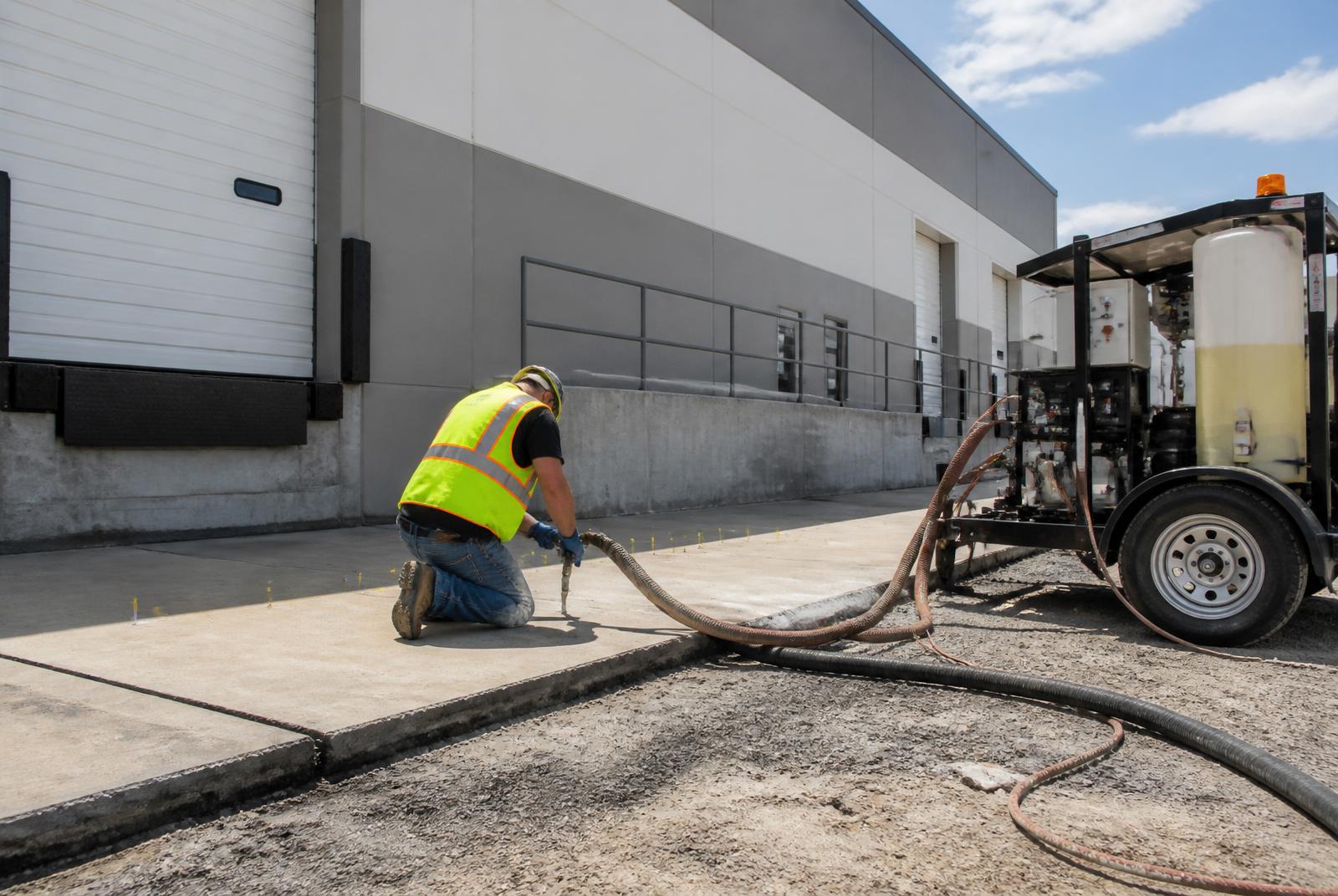
Injected under the slab through dime-sized holes. Lifts and stabilizes the driveway in one visit. Same-day drive-on.
Mudjacking (traditional slurry)
Older method using cement slurry pumped through 2" holes. Heavier material, larger patches, longer cure. Still works but is being phased out for driveways.
Full or partial replacement
Right answer when the slab itself is failing. Expect several days of no driveway plus significantly higher cost.
Do nothing / DIY caulking
Only appropriate for truly cosmetic hairline cracks. Doesn't address the underlying void — the driveway will keep settling.
Why polyurethane foam usually wins
The best fit for the vast majority of Spokane slabs.
- Cures in about 15 minutes — you can drive or walk on the slab the same day.
- Closed-cell foam doesn't wash out or absorb water like sand or slurry-based methods.
- Injection holes are dime-sized, not the golf-ball ports left by mudjacking.
- Lightweight — adds roughly 4 lbs per cubic foot vs. 100+ lbs for mud slurry, so it won't re-settle weak soil.
- Stabilizes the underlying soil at the same time it lifts the slab.
For a full comparison, see polyurethane foam vs. mudjacking in the Learning Center.
When replacement may be necessary
The honest cases where leveling isn't the right call.
- The slab is crumbling, spalling apart, or shattered with structural cracks — there's no solid piece left to lift.
- The concrete is very thin (below ~3 inches) and would crack under the lift pressure.
- You're changing the layout — widening a driveway, moving a patio, adding a new pour.
- Reinforcement is severely rusted and the slab is delaminating.
More detail in concrete leveling vs. replacement.
Frequently asked questions
Straight answers from Spokane homeowners.
- How much does it cost to fix a sinking driveway in Spokane?
- Most residential driveway leveling projects in Spokane fall in a wide range depending on square footage, drop, and access. See our Spokane driveway leveling cost guide for real local ranges — every real quote requires an on-site walkthrough.
- How long does a foam-lifted driveway last?
- The lift itself is permanent — polyurethane foam doesn't degrade. The slab will last as long as the concrete does, provided the drainage causing the original settlement is corrected.
- Can you fix a driveway that's sunk against the garage?
- Yes — this is one of the most common lifts we do in Spokane. Foam is injected along the garage-side edge and the slab is raised back to meet the garage floor.
- Do I have to replace my driveway if it has big cracks?
- Not necessarily. If the pieces are still structurally sound and the cracks came from settlement, lifting the slab often closes them significantly and stops the movement.
- Will leveling my driveway damage my landscaping?
- Foam injection is minimally invasive — dime-sized holes, no excavation, no heavy equipment on your lawn. Landscaping is typically untouched.
- How soon can I drive on it after the lift?
- Polyurethane foam reaches driving strength in roughly 15 minutes. Most driveways are back in service the same afternoon.
- Why does one side of my driveway sink and not the other?
- Almost always drainage. One side is catching more water — from a downspout, a slope, or an underground path — and losing soil the other side isn't losing.
- Does homeowner's insurance cover a sinking driveway?
- Usually no. Settlement is treated as gradual, not sudden, so it's typically excluded. See the related article on homeowner's insurance and concrete settlement for detail.
- Do you service Spokane Valley, Liberty Lake, and Coeur d'Alene?
- Yes — we lift driveways across Spokane, Spokane Valley, Liberty Lake, Post Falls, and Coeur d'Alene.
Related services
Explore the services that solve this problem.
Considering budget? Driveway leveling cost in Spokane.
Related problems
Other homeowner questions we hear.
From the Learning Center
Related reading before you request an estimate.
Free estimate — no obligation
Fix it before the next wet season.
Settlement compounds. Every rainstorm and freeze/thaw cycle makes the void bigger. Get an honest walkthrough now and know exactly what your options are.
Lift it — don't replace it.
Have questions about your concrete? Need advice? Want a free estimate? We're here to help. Concrete leveling saves the slab you already have, at a fraction of the cost of replacement.
- Often less costly and less disruptive than tear-out and replacement
- Repair before replacement when appropriate
- Modern concrete lifting methods
- Clear recommendations — no pressure, no upsells
Free Estimates · Spokane-Focused Service · Clear Recommendations