Commercial Concrete Leveling in Spokane, WA
Lift settled commercial slabs — warehouse floors, storefront sidewalks, loading docks, and parking areas — without shutting down operations. Polyurethane foam injection for property managers, contractors, and business owners across the Spokane area.
Free Estimate · Certificates of Insurance · Flexible Scheduling
Overview
Commercial slabs settle for the same reasons — the fixes look different.
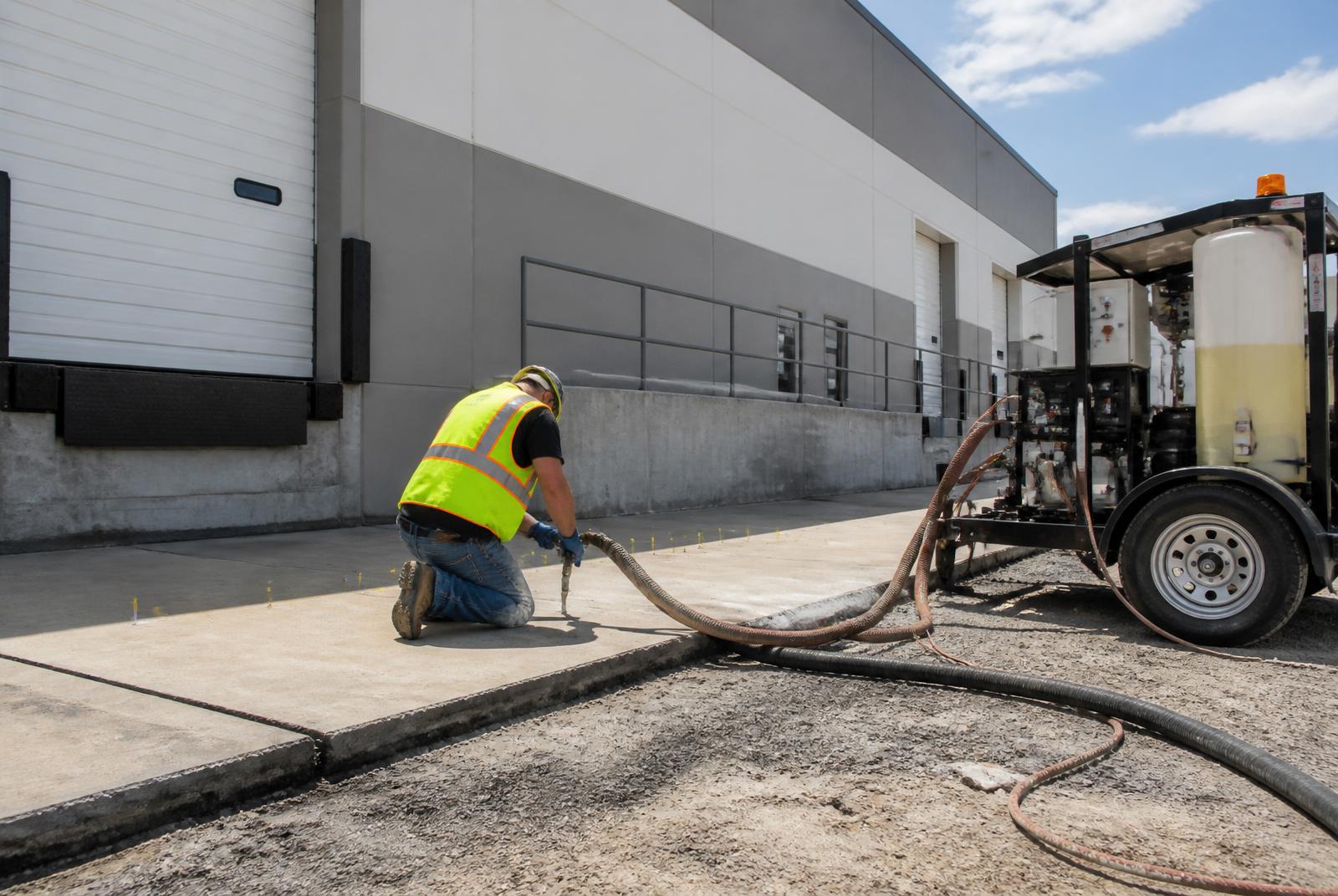
Warehouse floors, storefront sidewalks, loading zones, and parking areas all settle for the same underlying reasons: soil beneath the slab loses volume, water washes fines out from the base, or repeated loads compact the ground unevenly. The difference on commercial property is that shutting down for a full replacement usually isn't an option.
Polyurethane concrete leveling is well suited to commercial settings because it works in sections, cures quickly, and produces very little demolition or debris. Most jobs can be scheduled around business hours, tenant operations, or specific loading windows — so the surface stays in use.
Commercial services
Explore commercial concrete leveling by property type.
Dedicated resources for the property types we most often work with in Spokane. Additional service pages will be published as demand grows.
- View service page
Warehouse Floor Repair
Level settled interior slabs under racking, forklifts, and heavy equipment.
- View service page
HOA Sidewalk Repair
Fix trip hazards on common-area sidewalks and shared walkways at scale.
- View service page
Apartment Complex Concrete Repair
Repair settled walkways, entries, and pool decks without displacing tenants.
- View service page
Municipal Sidewalk Repair
ADA-compliant sidewalk trip hazard repair for cities and public works.
Industrial Floor Repair
Manufacturing and distribution slab lifting for heavy-load environments.
Coming soonRequest a quote →Church Concrete Repair
Sanctuary walkways, entries, and parking lot slab leveling.
Coming soonRequest a quote →School Sidewalk Repair
Trip hazard removal for K–12 and campus walkways.
Coming soonRequest a quote →Hospital Concrete Repair
Low-disruption slab leveling for medical campuses and clinics.
Coming soonRequest a quote →Office Building Concrete Repair
Entry sidewalks, plazas, and courtyards for commercial offices.
Coming soonRequest a quote →Retail Shopping Center Concrete Repair
Storefront sidewalks and parking lot slab lifting for retail centers.
Coming soonRequest a quote →Parking Lot Trip Hazard Repair
Level sunken panels and vertical offsets in commercial parking lots.
Coming soonRequest a quote →ADA Sidewalk Compliance
Bring settled sidewalks back into ADA vertical offset compliance.
Coming soonRequest a quote →
Applications
Commercial slabs we regularly level.
Whether it's a warehouse floor, a storefront sidewalk, or a parking lot panel, the process is the same — lift the slab, fill the void, keep the surface in service.
Warehouse & industrial floors
Settled interior slabs under racking, forklifts, and heavy equipment can be lifted in sections with minimal disruption to daily operations.
Storefront sidewalks & entrances
Uneven sidewalks and dropped entryway slabs create trip hazards for customers and staff. Leveling restores a safe, ADA-friendly walking surface.
Loading docks & apron slabs
Repeated truck traffic and heavy equipment loads compact the base under loading zones. Foam injection restores support without demolishing the dock.
Parking lots & drive lanes
Settled parking panels, dropped drive lanes, and pooling water around drains can often be corrected without removing the surrounding pavement.
Commercial patios & courtyards
Restaurants, offices, and multifamily properties with settled outdoor slabs benefit from a fast, low-noise repair that keeps the space in use.
Property management & HOA properties
Common-area sidewalks, community mailboxes, and shared walkways can be repaired one section at a time to fit turnover and maintenance schedules.
Why commercial slabs settle
It almost always starts beneath the concrete.
A commercial slab is only as stable as the soil supporting it. Here are the drivers we see most often on commercial property.
Heavy loads & repeated traffic
Commercial slabs carry forklifts, trucks, and equipment that quickly reveal weak spots in the base. Over time the soil beneath compacts unevenly and the slab drops.
Water infiltration
Downspouts, drain lines, and washouts near loading zones can move fine soils out from under a slab and open voids beneath the concrete.
Poor original compaction
Slabs poured over fill that was not compacted in thin, uniform lifts settle unevenly for years after construction.
Freeze-thaw activity
Spokane winters send water into joints and cracks. Repeated freeze-thaw cycles gradually shift the slab and open voids in the base.
Signs you may need commercial concrete leveling
How to tell if a slab is a candidate.
These are the warning signs we see most often during commercial site walks in the Spokane area.
- ✓
Trip hazards at storefronts and entrances
Vertical offsets between slabs are a liability risk for customers and employees, especially in high-traffic entry zones.
- ✓
Water pooling near drains
Puddles that linger long after rain often indicate low spots where a slab has settled below the original grade.
- ✓
Cracks around loading zones
Diagonal cracks and widening joints around loading docks and apron slabs often signal the base has failed under repeated loads.
- ✓
Uneven warehouse floors
Sloping floors, gaps at column bases, or racks that no longer sit level often trace back to slab settlement underneath.
- ✓
Sunken parking panels
Dropped panels in a parking lot are both a drainage problem and a liability. Left alone, they usually spread.
- ✓
Gaps at building foundations
Slabs that have pulled away from an exterior wall usually mean the soil supporting the slab has moved.
Not Sure What You're Looking At?
Send photos or schedule a free on-site walkthrough — we'll give you a straight answer.
How commercial concrete leveling works
A step-by-step look at what happens on site.
The process is designed to be minimally invasive and easy to fit around business operations.
- 01
Site walkthrough
A specialist walks the property with your facilities or property manager, measures settlement, and evaluates access, drainage, and operating hours.
- 02
Scoped estimate
You receive a written estimate that outlines what will be repaired, how long it should take, and any staging needed to keep the business running.
- 03
Small drilled ports
Dime-sized injection ports are drilled in planned locations so the lift can be controlled and the repair blends into the existing surface.
- 04
Polyurethane foam injection
A two-part polyurethane material is injected through the ports. It expands beneath the slab to fill voids, densify loose soil, and provide new support.
- 05
Controlled lifting
As the foam expands, the technician monitors the slab with levels and reference marks, adjusting placement to bring the concrete back to grade.
- 06
Return to service
Polyurethane cures quickly. Most commercial surfaces can be returned to normal traffic soon after the work is finished — often the same day.
Benefits
Why property managers choose leveling over replacement.
Minimal downtime
Most commercial jobs finish in hours, not days. Foam cures fast enough that many areas can be reopened to traffic the same day.
Reduced liability
Bringing settled slabs back to grade removes trip hazards at entrances, sidewalks, and common areas — reducing risk for customers and staff.
Preserves existing concrete
Lifting the slabs you already have keeps the original surface intact and avoids the cost and disruption of full demolition and replacement.
Low-noise, low-disruption
No jackhammers, no demolition debris, no extended closures — a much better fit for occupied commercial spaces than full replacement.
Cleaner outcome
No color mismatch from fresh pours next to aged concrete, and no long cure time before the surface can be used again.
Flexible scheduling
We can stage work by section, after hours, or on weekends to fit tenant operations, loading windows, and business hours.
Leveling vs. replacement
Both approaches have a place — here's how to decide.
When leveling may be appropriate
- The concrete is structurally sound and mostly intact
- Settlement is caused by voids or loose soil, not failing concrete
- The business needs to stay open during and after the repair
- The goal is to correct drainage, remove trip hazards, or restore grade
- Full replacement is impractical due to cost, downtime, or access
When replacement may be recommended
- The slab is severely crumbling, spalling, or breaking apart
- Multiple deep, active cracks run across the concrete
- The base is compromised in ways that lifting cannot address long-term
- The property owner wants to change the layout, load rating, or use
- An engineer or building official recommends replacement
For a broader comparison, read our Learning Center guide on concrete leveling vs. concrete replacement.
Frequently asked questions
Property manager and business owner questions.
- Can commercial slabs be leveled without shutting down operations?
- In most cases, yes. Foam injection is section-by-section work with minimal noise and no demolition, so it can often be staged around operating hours, loading windows, or tenant schedules. We plan access and traffic control during the estimate.
- How long does commercial concrete leveling last?
- Polyurethane foam is a stable, water-resistant material designed for concrete lifting. When the underlying cause of settlement — such as poor drainage — is also addressed, many commercial slabs see long-lasting results. Any slab can shift again if new voids form, so we look for root causes during the estimate.
- Can warehouse floors be lifted while racking is in place?
- Sometimes. It depends on rack layout, load ratings, and access. During the estimate we identify which sections can be lifted with racking in place versus areas that need temporary staging. See our commercial services in the sitewide list of related pages below.
- How soon can the surface be used again?
- Polyurethane foam cures quickly. Most driveways, sidewalks, and warehouse floors can be returned to normal traffic soon after the work is finished. Your specialist confirms timing based on the slab, temperature, and site conditions.
- How much does commercial concrete leveling cost?
- Cost depends on the size of the area, the amount of lift needed, and access to the work zone. Commercial jobs typically cost a fraction of full replacement. Every project gets a written, itemized estimate.
- Do you work with property managers and general contractors?
- Yes. We regularly work directly with property managers, facility teams, and general contractors on scheduling, insurance certificates, and phased scopes.
- Is polyurethane better than mudjacking for commercial slabs?
- For most commercial applications, polyurethane foam has clear advantages: smaller injection holes, lighter weight per cubic foot than a cement slurry, faster cure times, and better resistance to washout. See our Learning Center guide on polyurethane foam vs. mudjacking for a full comparison.
- Do you provide certificates of insurance?
- Yes. We can provide certificates of insurance and coordinate with your risk or compliance team before starting work.
Why Spokane businesses choose us
Straightforward service from a local team.
Free estimates
Every commercial inspection is free. You receive a written estimate and a clear scope with no obligation to move forward.
Honest recommendations
If replacement is the better call for a specific area, we will say so. We would rather earn a smaller repair today than oversell one that will not hold up.
Modern repair methods
We focus on polyurethane foam injection — a lightweight, water-resistant material designed specifically for concrete lifting.
Flexible scheduling
Work can be staged after hours, on weekends, or section-by-section to fit tenant operations and business hours.
Local Spokane team
We live and work in the Spokane area. We understand local soils, drainage challenges, and how our winters affect commercial concrete.
Related concrete services
Explore the rest of our concrete leveling services.
Service area
Commercial concrete leveling across Spokane and nearby communities.
We serve Spokane, Spokane Valley, Liberty Lake, Airway Heights, Cheney, Mead, and surrounding areas with flexible commercial scheduling.
- Spokane
- Spokane Valley
- Liberty Lake
- Airway Heights
- Cheney
- Mead
- Nine Mile Falls
- Deer Park
Contact us
Have questions or need an estimate? Let's talk.
A short walkthrough is often the difference between a costly tear-out and a same-day repair. Call, email, or request an estimate online.
Explore more
Related Services
Concrete leveling and lifting solutions for every surface around your Spokane property.
Lift it — don't replace it.
Have questions about your concrete? Need advice? Want a free estimate? We're here to help. Concrete leveling saves the slab you already have, at a fraction of the cost of replacement.
- Often less costly and less disruptive than tear-out and replacement
- Repair before replacement when appropriate
- Modern concrete lifting methods
- Clear recommendations — no pressure, no upsells
Free Estimates · Spokane-Focused Service · Clear Recommendations