Why Does Concrete Sink Around Downspouts?
If concrete is sinking on your property, there's a very good chance a downspout is doing the damage. Here's the erosion pattern, why it accelerates in the Inland Northwest, and how to correct both the slab and the water source in one visit.
Free On-Site Estimate · Serving Spokane & the Inland Northwest
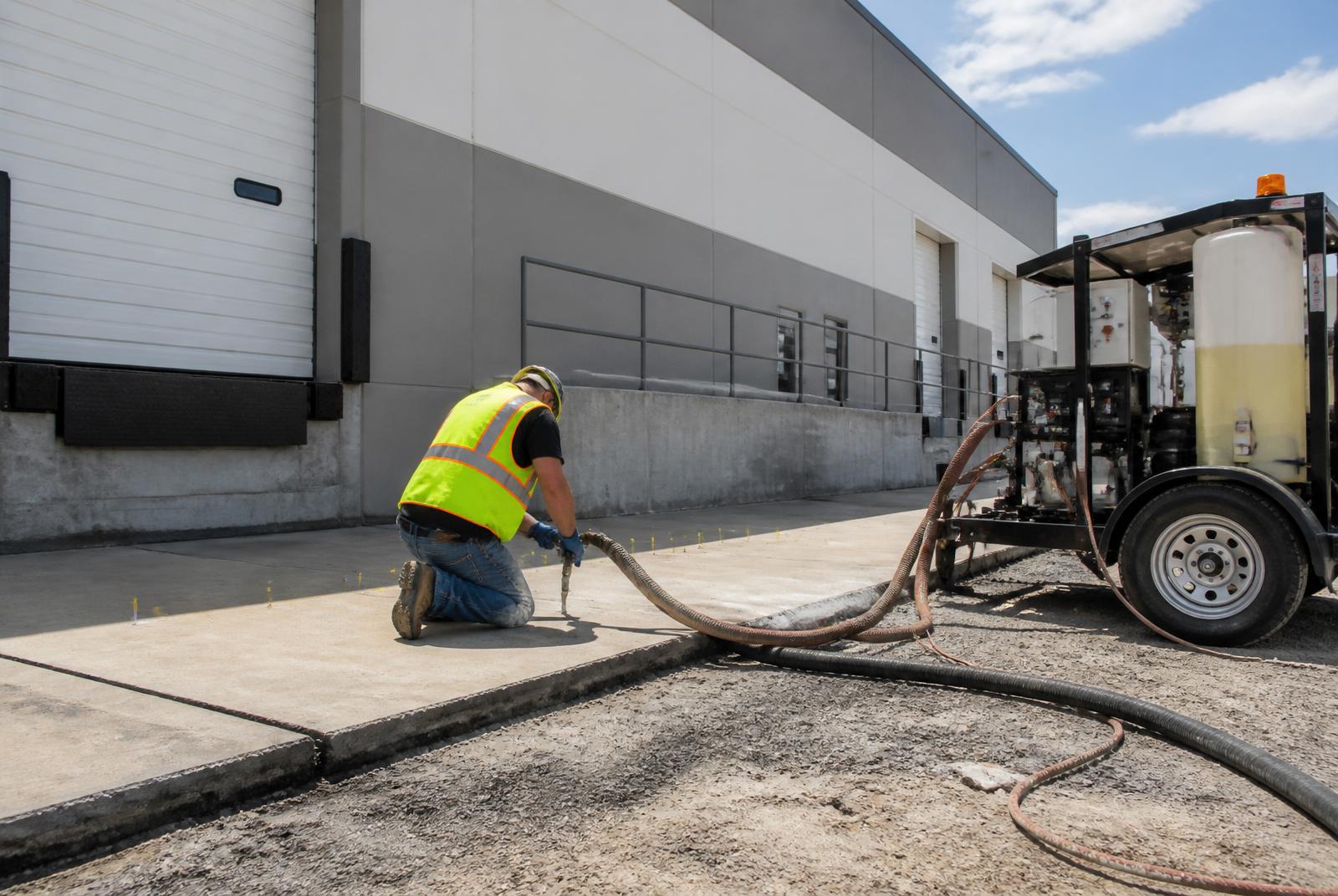
Problem overview
What's actually happening.
A single downspout can dump the runoff from hundreds of square feet of roof onto a spot the size of a doormat. On any slab within a few feet of that discharge, the subgrade is being flushed several times a season.
In Spokane, downspouts are the single most common cause of concrete settlement — driveways, patios, sidewalks, and front porches all sink faster near a downspout than anywhere else on the property.
The right fix has two parts: lift the slab back into position and redirect the water so the void doesn't reopen. Doing one without the other is a partial fix.
For the underlying service, see concrete leveling. Serving Spokane, WA and the surrounding Inland Northwest. Ready to skip ahead? Request a free estimate.
Signs to watch for
How this problem shows up.
A visible dip right where a downspout discharges
The classic signature — settlement matches the water footprint.
Erosion channels in nearby dirt or mulch
The water is moving fast enough to carry soil visibly.
Standing water near the downspout after a rain
The subgrade is saturated and the slab has moved to hold water.
Cracks radiating from the downspout side of a slab
The unsupported section is fracturing.
Efflorescence blooming near the discharge
Water is soaking into the concrete edge.
A splash block that's tilted or half-buried
The soil below the splash block has washed out.
Common causes
Why it happens in the Inland Northwest.
Spokane's freeze/thaw cycles, clay-and-silt soils, and heavy seasonal runoff produce a fairly predictable set of root causes.
Concentrated roof water
Hundreds of square feet of roof draining onto a few square feet of ground.
Short downspout extensions or no extension at all
Water hits the ground directly against the house or slab.
Poor grading around the discharge point
Ground sloping toward the slab captures and directs the water under it.
Freeze/thaw cycling on saturated soil
Every Spokane winter reworks the wet spot under the slab.
Clay or silt soils that erode readily under flow
Common across the Inland Northwest.
How to determine severity
Read your slab like a pro.
A quick self-triage. When in doubt, request a free on-site walkthrough.
- Slight dip, no cracking: cosmetic, but the erosion is active. Fix now.
- Dip plus visible cracks radiating: moderate — the void is real.
- Water actively running toward the house or into the garage: high priority.
- Slab is broken along the downspout side: significant. Level immediately and correct drainage.
- Interior moisture on the wall above the discharge: the water is finding a path in. Urgent.
Not sure how bad it is?
Get a free walkthrough before it gets worse.
We'll measure the drop, check for voids, evaluate the drainage, and give you an honest recommendation — including whether it's a leveling job or something else.
Why waiting makes it worse
Settlement doesn't fix itself.
Every cause listed above keeps working whether or not the slab is addressed.
- Every rainstorm makes the void bigger.
- Freeze/thaw compounds the wet subgrade damage.
- Water reaching the foundation escalates the fix from a slab job to a waterproofing project.
- The lift required grows and often turns into a partial replacement.
- Adjacent slabs — a walk, a step, a patio — start following the same failure pattern.
Repair options
What are your choices?
An honest comparison — the right fix depends on the slab, the cause, and the goal.
Polyurethane foam leveling
Foam is injected under the settled slab to lift it back into position.
Downspout extension, splash block, or buried drain line
Move the water out beyond the slab — always paired with the lift.
Regrading adjacent beds and lawn
Small grading corrections keep water moving away from the slab.
Full replacement
Reserved for slabs that have failed structurally along the discharge line.
Why polyurethane foam usually wins
The best fit for the vast majority of Spokane slabs.
- Cures in about 15 minutes — you can drive or walk on the slab the same day.
- Closed-cell foam doesn't wash out or absorb water like sand or slurry-based methods.
- Injection holes are dime-sized, not the golf-ball ports left by mudjacking.
- Lightweight — adds roughly 4 lbs per cubic foot vs. 100+ lbs for mud slurry, so it won't re-settle weak soil.
- Stabilizes the underlying soil at the same time it lifts the slab.
For a full comparison, see polyurethane foam vs. mudjacking in the Learning Center.
When replacement may be necessary
The honest cases where leveling isn't the right call.
- The slab is crumbling, spalling apart, or shattered with structural cracks — there's no solid piece left to lift.
- The concrete is very thin (below ~3 inches) and would crack under the lift pressure.
- You're changing the layout — widening a driveway, moving a patio, adding a new pour.
- Reinforcement is severely rusted and the slab is delaminating.
More detail in concrete leveling vs. replacement.
Frequently asked questions
Straight answers from Spokane homeowners.
- How far should a downspout discharge from the house or slab?
- As a rule of thumb, at least 4–6 feet, ideally to a point where water can flow away without pooling. Buried drain lines to daylight are ideal.
- Can you fix both the slab and the downspout?
- Yes — most projects include the leveling and the drainage correction in the same visit.
- Will lifting the slab last if I don't fix the downspout?
- The lift itself is permanent, but the void will reopen from below if concentrated water keeps flowing there. Fix both.
- Do splash blocks work?
- They help, but on a heavy downspout in Spokane they're often not enough. A buried extension to a lawn point is more reliable.
- Is this an emergency?
- Not usually, but it's the kind of problem that goes from small and cheap to significant quickly. Fix it before the next wet season.
- How soon can I use the slab after the lift?
- Within an hour for walkable use; same afternoon for a driveway.
- Do you service Spokane Valley and Coeur d'Alene?
- Yes — this is the most common call we take across the Inland Northwest.
- Does homeowner's insurance cover this?
- Usually no. Settlement is gradual and typically excluded. See the related article for detail.
Related services
Explore the services that solve this problem.
Related problems
Other homeowner questions we hear.
From the Learning Center
Related reading before you request an estimate.
Free estimate — no obligation
Fix it before the next wet season.
Settlement compounds. Every rainstorm and freeze/thaw cycle makes the void bigger. Get an honest walkthrough now and know exactly what your options are.
Lift it — don't replace it.
Have questions about your concrete? Need advice? Want a free estimate? We're here to help. Concrete leveling saves the slab you already have, at a fraction of the cost of replacement.
- Often less costly and less disruptive than tear-out and replacement
- Repair before replacement when appropriate
- Modern concrete lifting methods
- Clear recommendations — no pressure, no upsells
Free Estimates · Spokane-Focused Service · Clear Recommendations