What Causes Concrete Settlement?
Concrete settlement is almost always a soil problem — the slab is fine, but what's under it isn't. Here's a plain-English walk-through of the real causes and what each one looks like in the Inland Northwest.
Free On-Site Estimate · Serving Spokane & the Inland Northwest
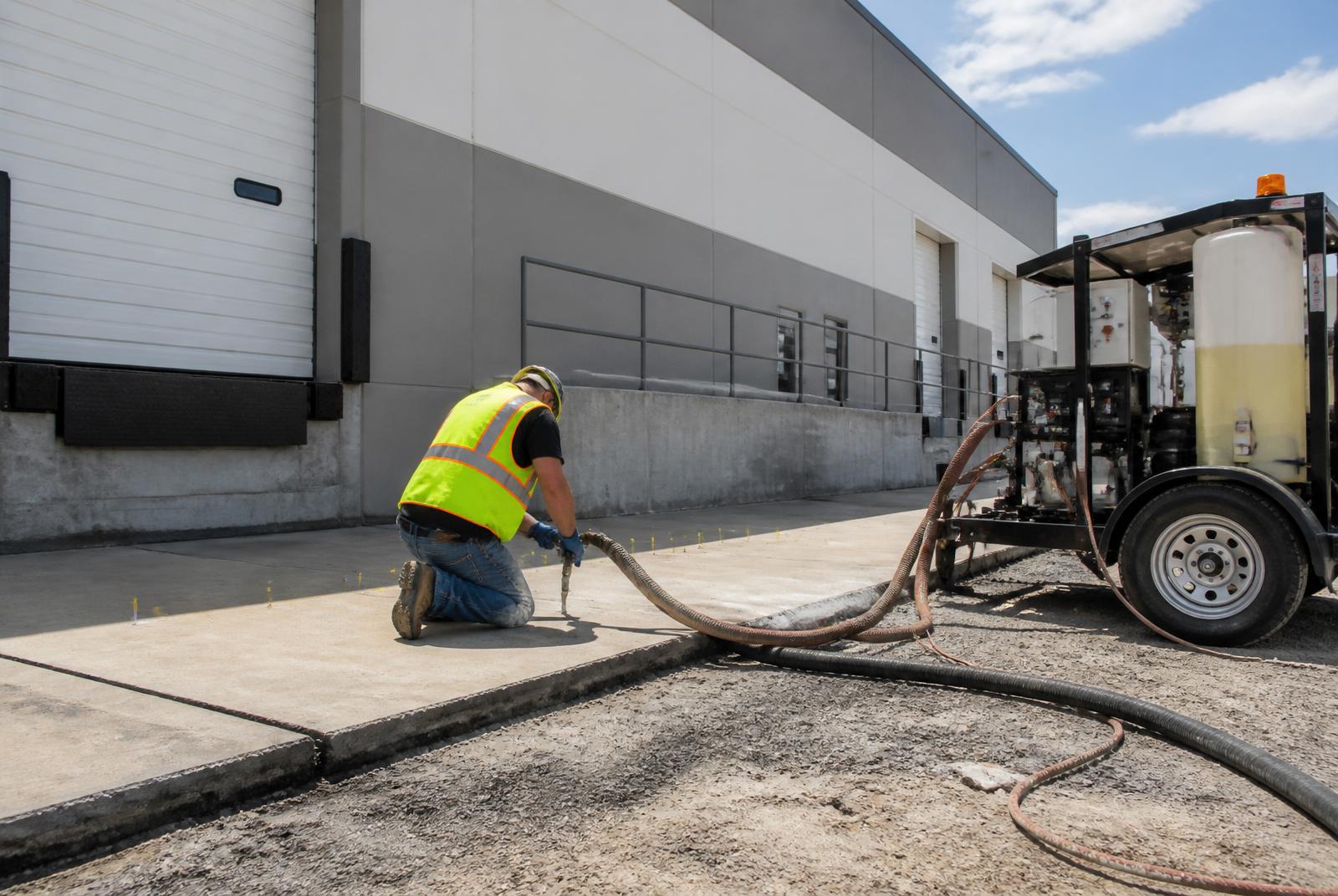
Problem overview
What's actually happening.
When homeowners see a sinking slab, the natural assumption is that the concrete failed. In almost every case, the concrete itself is fine. What changed is the ground underneath.
Understanding the cause matters, because the fix depends on it. A slab that dropped from a downspout is fixed differently — and lasts differently — than one that dropped from a decomposing tree root or a compacting fill lot.
This page walks through the six causes we see repeatedly across Spokane, Spokane Valley, Liberty Lake, Post Falls, and Coeur d'Alene, and what each one looks like at the surface.
For the underlying service, see concrete leveling. Serving Spokane, WA and the surrounding Inland Northwest. Ready to skip ahead? Request a free estimate.
Signs to watch for
How this problem shows up.
Uneven or dropping slab edges
The most direct evidence — a slab that's out of level with itself or its neighbors.
Cracks running from an edge inward
Unsupported sections fracture along predictable lines.
Rocking or hollow panels
A void has opened up under the slab.
Water pooling in a new location
Slope has shifted as one section dropped.
Gaps between slabs and adjacent structures
The floating slab moved; the structure didn't.
Efflorescence, mud lines, or erosion channels
Water and soil movement leaving visible tracks.
Common causes
Why it happens in the Inland Northwest.
Spokane's freeze/thaw cycles, clay-and-silt soils, and heavy seasonal runoff produce a fairly predictable set of root causes.
Poorly compacted fill from original construction
The single largest cause on suburban homes 10–30 years old. Fill compresses for years.
Water intrusion under the slab
Downspouts, sprinklers, and poor grading push water where it saturates and erodes subgrade.
Freeze/thaw cycling
Spokane winters expand and contract wet subgrade dozens of times per season, opening voids.
Expansive clay soils
Common in the Inland Northwest — cycle wet-to-dry and pull soil away from the slab.
Tree roots — live and decaying
Live roots lift; dead roots decompose and drop the slab into the void.
Utility trenches under or beside the pour
Backfill in trenches settles for years after the utility work is finished.
How to determine severity
Read your slab like a pro.
A quick self-triage. When in doubt, request a free on-site walkthrough.
- Slight edge drop, hairline cracks: cosmetic — but the underlying cause is active.
- ½–1½ inch drop plus cracking: moderate. Fix before the next wet season.
- 1½+ inch drop, rocking panels, water pooling: significant.
- Broken slabs, wide cracks, hollow sounds: the void is real and growing.
- Water reaching the foundation or interior: urgent — this is now beyond a slab issue.
Not sure how bad it is?
Get a free walkthrough before it gets worse.
We'll measure the drop, check for voids, evaluate the drainage, and give you an honest recommendation — including whether it's a leveling job or something else.
Why waiting makes it worse
Settlement doesn't fix itself.
Every cause listed above keeps working whether or not the slab is addressed.
- Every listed cause continues to work whether or not you address the slab.
- Cracks widen and break slabs into unliftable pieces.
- Water intrusion migrates toward the foundation.
- Freeze/thaw damage accelerates on saturated slabs.
- The lift required grows, and the price with it.
Repair options
What are your choices?
An honest comparison — the right fix depends on the slab, the cause, and the goal.
Polyurethane foam leveling
Address the slab by lifting it and stabilizing the fill in a single injection process.
Drainage correction
Extend downspouts, regrade, redirect sprinklers, add drains — pair with leveling for lasting fix.
Mudjacking
Older method. Works, but heavier, larger holes, longer cure, and slurry can wash out.
Selective or full replacement
For slabs that are structurally failing, thin, or where layout is being changed anyway.
Why polyurethane foam usually wins
The best fit for the vast majority of Spokane slabs.
- Cures in about 15 minutes — you can drive or walk on the slab the same day.
- Closed-cell foam doesn't wash out or absorb water like sand or slurry-based methods.
- Injection holes are dime-sized, not the golf-ball ports left by mudjacking.
- Lightweight — adds roughly 4 lbs per cubic foot vs. 100+ lbs for mud slurry, so it won't re-settle weak soil.
- Stabilizes the underlying soil at the same time it lifts the slab.
For a full comparison, see polyurethane foam vs. mudjacking in the Learning Center.
When replacement may be necessary
The honest cases where leveling isn't the right call.
- The slab is crumbling, spalling apart, or shattered with structural cracks — there's no solid piece left to lift.
- The concrete is very thin (below ~3 inches) and would crack under the lift pressure.
- You're changing the layout — widening a driveway, moving a patio, adding a new pour.
- Reinforcement is severely rusted and the slab is delaminating.
More detail in concrete leveling vs. replacement.
Frequently asked questions
Straight answers from Spokane homeowners.
- Is settlement the concrete's fault?
- Almost never. The slab is following the soil that's supporting it — or failing to.
- How can I tell which cause is mine?
- The location of the drop usually tells the story. Under a downspout: water. Along the house on a young home: backfill. Under a tree that used to be there: decomposition. On-site inspection confirms it.
- Can leveling stop settlement from continuing?
- It can permanently lift the slab. The subgrade cause needs to be addressed for the fix to hold.
- Does insurance pay for settlement damage?
- Usually no — gradual settlement is typically excluded. See the linked article for detail.
- How long does foam leveling last?
- Indefinitely. Foam doesn't compress or degrade. The lifespan is set by drainage.
- Should I fix drainage before or with the lift?
- During the same project is ideal. Waiting invites the void to reopen.
- Is this problem specific to Spokane?
- The pattern is the same across the Inland Northwest. Spokane's climate makes it happen faster.
- Do you serve the whole region?
- Yes — Spokane, Spokane Valley, Liberty Lake, Post Falls, and Coeur d'Alene.
Related services
Explore the services that solve this problem.
Related problems
Other homeowner questions we hear.
From the Learning Center
Related reading before you request an estimate.
Free estimate — no obligation
Fix it before the next wet season.
Settlement compounds. Every rainstorm and freeze/thaw cycle makes the void bigger. Get an honest walkthrough now and know exactly what your options are.
Lift it — don't replace it.
Have questions about your concrete? Need advice? Want a free estimate? We're here to help. Concrete leveling saves the slab you already have, at a fraction of the cost of replacement.
- Often less costly and less disruptive than tear-out and replacement
- Repair before replacement when appropriate
- Modern concrete lifting methods
- Clear recommendations — no pressure, no upsells
Free Estimates · Spokane-Focused Service · Clear Recommendations