What Causes Uneven Concrete?
Whether it's a lifted sidewalk panel, a sinking driveway, or a tilted patio, uneven concrete comes from a small number of causes. Here's what they are and how to tell which one is affecting your slab.
Free On-Site Estimate · Serving Spokane & the Inland Northwest
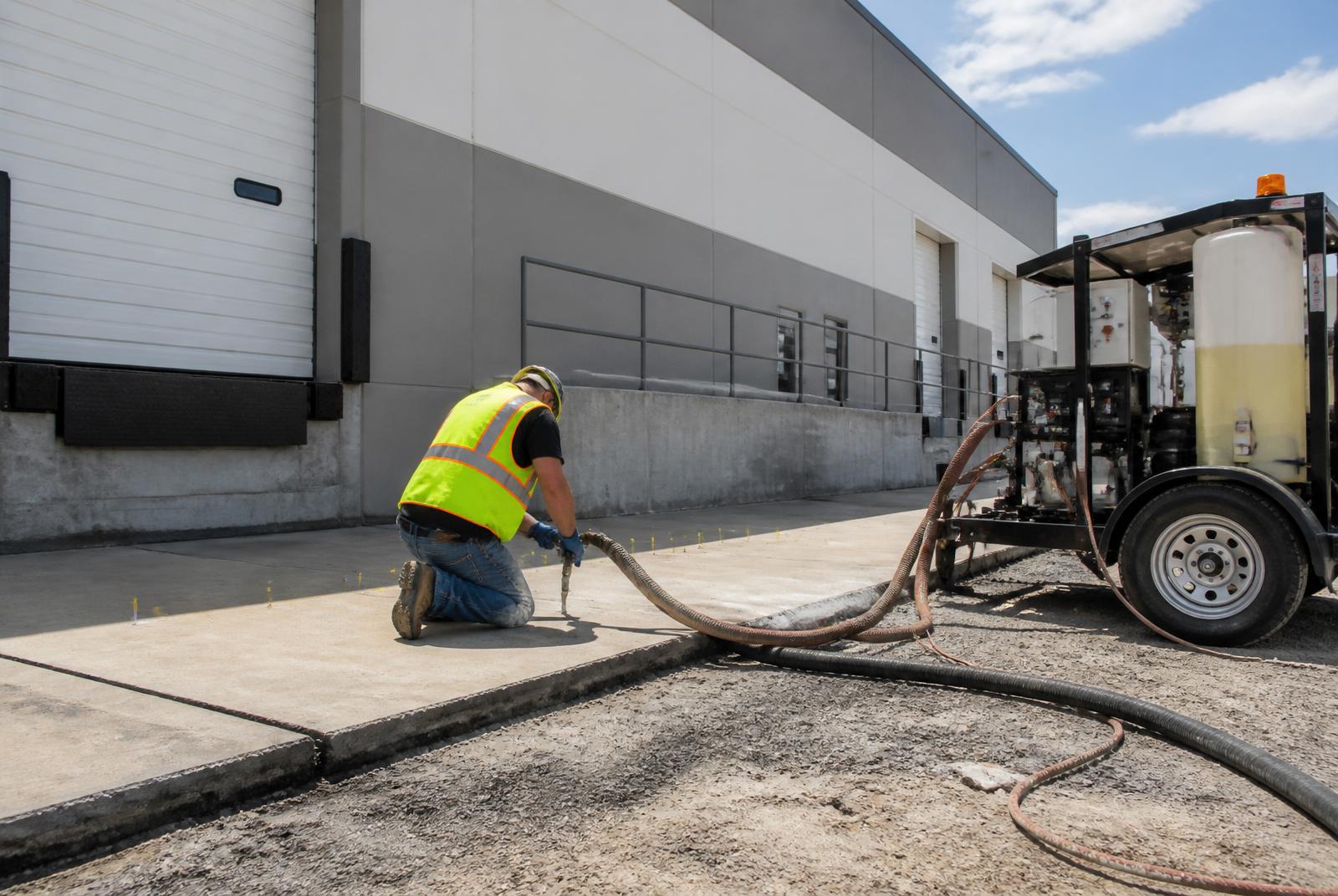
Problem overview
What's actually happening.
Concrete is essentially rigid — it doesn't stretch, flex, or shrink meaningfully once cured. That means uneven concrete is always the result of something else moving underneath it, or something pushing against it from outside.
In Spokane, the pattern is remarkably consistent: a small set of causes account for the vast majority of unevenness we see across driveways, sidewalks, patios, garage floors, and porches.
This page walks through those causes so you can identify what's happening to your slab and make a confident call about whether it's a leveling job, a drainage job, a root job — or a combination.
For the underlying service, see concrete leveling. Serving Spokane, WA and the surrounding Inland Northwest. Ready to skip ahead? Request a free estimate.
Signs to watch for
How this problem shows up.
One slab lower than its neighbor
Settlement — the low one dropped, or the high one lifted.
A slab tilting sideways
One edge has lost support faster than the other.
Rocking or hollow panels
A void has opened up underneath.
A gap between a slab and an adjacent structure
The floating slab moved; the structure didn't.
Cracks running from an edge inward
Unsupported sections fracturing.
Water pooling where it didn't before
Slope has shifted.
Common causes
Why it happens in the Inland Northwest.
Spokane's freeze/thaw cycles, clay-and-silt soils, and heavy seasonal runoff produce a fairly predictable set of root causes.
Settlement — soil dropping under the slab
The most common cause. Water, fill compaction, freeze/thaw, or decomposition.
Heave — soil pushing the slab up
Freeze heave, expansive clays swelling wet, tree roots pushing under the slab.
Erosion — soil washing out laterally
Water flowing under and out from beneath the slab, undermining an edge.
Poor original grading or slope
The pour was never at the right pitch, and small movement flipped the drainage.
Adjacent structure movement
A neighboring slab lifted or dropped and pulled this one out of alignment.
How to determine severity
Read your slab like a pro.
A quick self-triage. When in doubt, request a free on-site walkthrough.
- Under ¼ inch difference: cosmetic. Easiest time to fix.
- ¼–½ inch: ADA-recognized trip hazard on walkways.
- ½–1½ inch: moderate — visible unevenness, functional impact.
- 1½+ inch or rocking, hollow, cracking: significant.
- Broken slabs, wide gaps, water intrusion: often requires selective replacement plus leveling.
Not sure how bad it is?
Get a free walkthrough before it gets worse.
We'll measure the drop, check for voids, evaluate the drainage, and give you an honest recommendation — including whether it's a leveling job or something else.
Why waiting makes it worse
Settlement doesn't fix itself.
Every cause listed above keeps working whether or not the slab is addressed.
- Unevenness grows — none of the causes stop working on their own.
- Trip hazards escalate liability.
- Water re-routes and often heads toward foundations.
- Cracks widen and slabs break into pieces that can't be lifted.
- The overall repair cost climbs as pieces need replacement instead of lifting.
Repair options
What are your choices?
An honest comparison — the right fix depends on the slab, the cause, and the goal.
Polyurethane foam leveling
Lifts settled slabs, fills voids, stabilizes subgrade — the standard fix for most unevenness.
Grinding high panels
Fast, cheap, but doesn't fix the underlying cause and often leaves a ramp.
Mudjacking
Works, but heavier, larger holes, longer cure than foam.
Root removal or barrier installation
For heave caused by live tree roots.
Selective replacement
For slabs broken beyond lifting.
Why polyurethane foam usually wins
The best fit for the vast majority of Spokane slabs.
- Cures in about 15 minutes — you can drive or walk on the slab the same day.
- Closed-cell foam doesn't wash out or absorb water like sand or slurry-based methods.
- Injection holes are dime-sized, not the golf-ball ports left by mudjacking.
- Lightweight — adds roughly 4 lbs per cubic foot vs. 100+ lbs for mud slurry, so it won't re-settle weak soil.
- Stabilizes the underlying soil at the same time it lifts the slab.
For a full comparison, see polyurethane foam vs. mudjacking in the Learning Center.
When replacement may be necessary
The honest cases where leveling isn't the right call.
- The slab is crumbling, spalling apart, or shattered with structural cracks — there's no solid piece left to lift.
- The concrete is very thin (below ~3 inches) and would crack under the lift pressure.
- You're changing the layout — widening a driveway, moving a patio, adding a new pour.
- Reinforcement is severely rusted and the slab is delaminating.
More detail in concrete leveling vs. replacement.
Frequently asked questions
Straight answers from Spokane homeowners.
- Can leveling fix concrete that's tilted the wrong direction?
- Yes — that's a major use case. Foam is placed in the pattern needed to restore correct pitch.
- How do you know if it's settlement or heave?
- Settlement drops the slab below its neighbors; heave lifts one above them. Both are common in Spokane; both are fixable.
- Will lifting one slab affect the neighbor?
- Not typically — lifts are targeted. Adjacent panels stay where they are.
- How much can you actually lift?
- From fractions of an inch to several inches. Most residential lifts are ½ to 2 inches.
- Is grinding ever the right answer?
- For a tiny trip lip on a panel that isn't otherwise moving, occasionally yes. For most uneven concrete, no — it doesn't fix the cause.
- How long does the fix last?
- Indefinitely with foam, provided drainage is corrected.
- Can you fix uneven concrete in one visit?
- Almost always yes. Most residential jobs are half a day.
- Do you serve the whole Inland Northwest?
- Yes — Spokane, Spokane Valley, Liberty Lake, Post Falls, and Coeur d'Alene.
Related services
Explore the services that solve this problem.
Related problems
Other homeowner questions we hear.
From the Learning Center
Related reading before you request an estimate.
Free estimate — no obligation
Fix it before the next wet season.
Settlement compounds. Every rainstorm and freeze/thaw cycle makes the void bigger. Get an honest walkthrough now and know exactly what your options are.
Lift it — don't replace it.
Have questions about your concrete? Need advice? Want a free estimate? We're here to help. Concrete leveling saves the slab you already have, at a fraction of the cost of replacement.
- Often less costly and less disruptive than tear-out and replacement
- Repair before replacement when appropriate
- Modern concrete lifting methods
- Clear recommendations — no pressure, no upsells
Free Estimates · Spokane-Focused Service · Clear Recommendations