Polyurethane foam vs. cement slurry.
Two very different materials go under a lifted slab. This page focuses on the material properties themselves — weight, water resistance, cure chemistry, longevity — so you understand what's actually holding your concrete up.
Free On-Site Estimate · Serving Spokane & the Inland Northwest
Overview
What we're actually comparing.
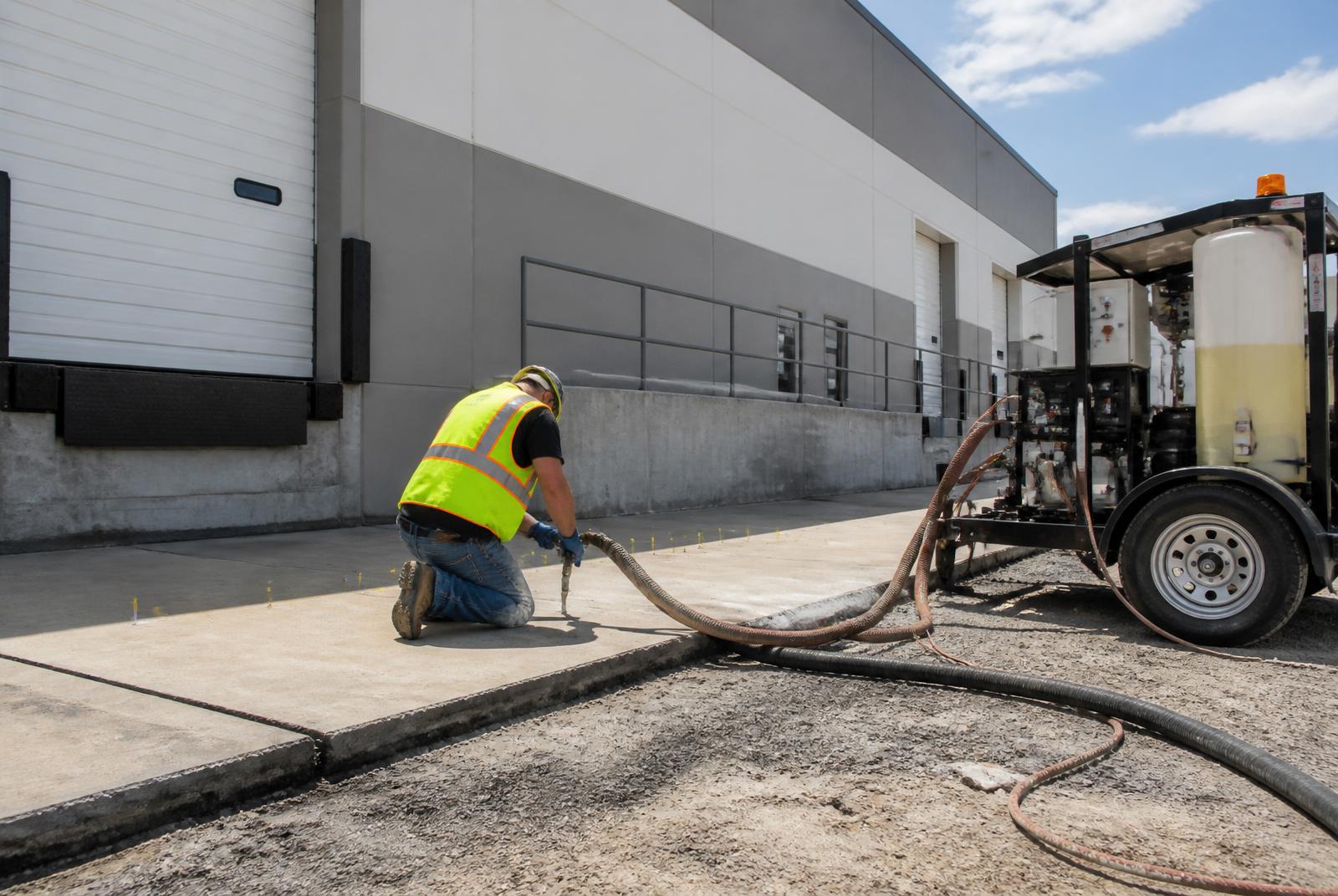
Every slab-lifting method comes down to what you put under the concrete. In the Spokane market, that's almost always either a cement-based slurry (mudjacking) or a two-part polyurethane foam.
The methods look similar from the driveway — a truck, a hose, some drilled holes — but the materials behave differently under Spokane's wet springs and hard winters. This page keeps the comparison at the material level.
For the underlying service, see concrete leveling. Serving Spokane, WA and the surrounding Inland Northwest. Ready to skip to a real recommendation? Request a free estimate.
The two options
A plain-English look at each method.
Polyurethane Foam
Closed-cell, water-insensitive expanding foam.
Polyurethane concrete-lifting foam is a two-part liquid that reacts and expands into a closed-cell structure. Once cured — about 15 minutes — the foam is dimensionally stable, hydrophobic, and roughly 4 pounds per cubic foot.
The closed-cell structure is the key material property: water can't penetrate cured foam, so it doesn't lose volume or strength when the subgrade gets wet.
Cement Slurry
A pumpable mix of cement, sand, and water.
Cement slurry is the workhorse of traditional mudjacking. Proportions vary by contractor, but the common thread is a heavy, wet mix pumped beneath the slab under pressure.
The cured slurry is essentially a low-strength concrete under your slab — heavy (often 100+ lbs per cubic foot), porous to some degree, and vulnerable to erosion in saturated soils.
Pros and cons
Honest tradeoffs for each option.
Polyurethane Foam
Pros
- Hydrophobic — doesn't absorb water or erode.
- Extremely lightweight — doesn't overload weak subgrades.
- Cures in ~15 minutes.
- Expands to fill small voids and cracks the pump can't reach directly.
Cons
- Higher material cost per cubic foot.
- Requires specialty two-part injection equipment.
Cement Slurry
Pros
- Well-understood material with decades of civil engineering data.
- Very high compressive strength once fully cured.
- Locally sourced components.
- Effective for very heavy loads on stable, dry subgrades.
Cons
- Heavy — pushes weak subgrades toward further settlement.
- Absorbs water and can slowly erode in wet or freeze-thaw soils.
- Long cure time before full load capacity.
- Requires larger injection ports and larger volume per lift.
Side by side
Cost, time, lifespan, warranty — one table.
Ranges reflect typical Spokane residential projects. Every real number comes from an on-site walkthrough.
| Factor | Polyurethane Foam | Cement Slurry |
|---|---|---|
| Cost (delivered, typical residential lift) | $700 – $2,500 | $500 – $1,800 |
| Time on site | 1–3 hours | 2–5 hours |
| Disruption | Small ports, minutes to reuse | Larger ports, hours to overnight |
| Expected lifespan | 20+ years | 5–10 years in wet soil |
| Warranty | 5–10 years typical | 1–5 years typical |
| Maintenance | Occasional joint seal | Watch for re-settlement |
| Environmental impact | Less material by weight; no demolition | Higher embodied carbon per lift |
| Best application | Wet or clay-heavy subgrades, residential slabs | Dry, dense subgrades under heavy commercial loads |
Spokane climate & soil
Freeze/thaw, clay soils, and drainage.
Spokane's clay-heavy soils retain moisture longer than sandy soils elsewhere in the country. That's the reason foam has taken over the local residential market — the same subgrade that makes cement slurry a maintenance risk is exactly where foam performs best.
For the same reason, the underside of a slab near a downspout, sprinkler line, or window well is nearly always a foam candidate.
Environmental impact
Which option is easier on the environment?
Cement production is one of the most carbon-intensive industrial processes. Polyurethane foam is a petrochemical product but uses far less material by weight per lift. Neither is 'green,' but foam typically carries the smaller per-project footprint.
Best use cases
When each option genuinely fits.
Best for Polyurethane Foam
- Any residential slab in the Inland Northwest.
- Slabs adjacent to persistent moisture sources.
- Decorative or stamped concrete where port size matters.
- Cases where downtime is unacceptable.
Best for Cement Slurry
- Heavy industrial floor slabs on stable, engineered subgrades.
- Rural infrastructure where cosmetics don't matter.
- Regions with dry, sandy soils.
When concrete leveling is the better call
Signals that lifting wins.
- Structurally sound slab that just moved.
- Water is a factor in the settlement.
- You want the fastest possible return-to-service.
Not sure which one fits your slab?
We'll give you an honest recommendation.
We come out, walk the slab, and tell you which method (or replacement) is the right buy — even when it isn't a job for us.
When replacement is honestly better
The cases where lifting isn't the right call.
- Slab is failed at the material level (spalling, crumbling).
- You want to reset the entire base and re-pour.
- Structural cracks run through the concrete.
Frequently asked questions
Straight answers from Spokane homeowners.
- Isn't heavier better under a slab?
- No — the strength you need is compressive resistance, not weight. Polyurethane foam has more than enough compressive strength for residential loads and doesn't stress the already-weak subgrade the way slurry does.
- Does polyurethane foam degrade over time?
- Cured closed-cell foam is chemically stable. UV can degrade exposed foam, but the foam is beneath the slab where it doesn't see sunlight.
- Can slurry actually erode?
- Yes — in saturated soils, the interface between cured slurry and the surrounding subgrade can wash out over years. This is one of the main reasons Spokane sees mudjacked slabs re-settle over a 5–10 year window.
- How long does foam last?
- The foam itself is dimensionally stable indefinitely. Practical lifespan of a foam lift is set by the slab and drainage, not the foam.
- What temperature does the foam cure at?
- Professional systems cure across a wide temperature range. Cold-weather projects use a formulation adjusted for winter conditions.
- Is one method safer for pets or plants?
- Both are safe once cured. Follow the installer's directions during application.
- Which method is quieter?
- Foam is generally quieter — the rig and process create less vibration. Mudjacking pumps can be noticeably louder.
- Can you mix methods?
- In some cases contractors use one method for deep voids and another for lift, but that's uncommon on residential work. Most jobs are one or the other.
Related services
Explore the services this comparison touches.
Keep researching
Related pricing, problem pages, and articles.
Learning Center
Serving Spokane and the surrounding Inland Northwest. Prefer to skip the reading? Request a free estimate.
Free estimate — no obligation
Get an honest recommendation for your slab.
Ranges are useful. A real recommendation is better. We come out, evaluate the slab, and tell you which method — or whether replacement — is actually the right buy.
Lift it — don't replace it.
Have questions about your concrete? Need advice? Want a free estimate? We're here to help. Concrete leveling saves the slab you already have, at a fraction of the cost of replacement.
- Often less costly and less disruptive than tear-out and replacement
- Repair before replacement when appropriate
- Modern concrete lifting methods
- Clear recommendations — no pressure, no upsells
Free Estimates · Spokane-Focused Service · Clear Recommendations