Sidewalk Leveling — Spokane, WA
A representative Spokane residential sidewalk project: three raised panels creating trip hazards along a front walk, lifted back into plane in a single visit.
Representative Project · Serving the Inland Northwest
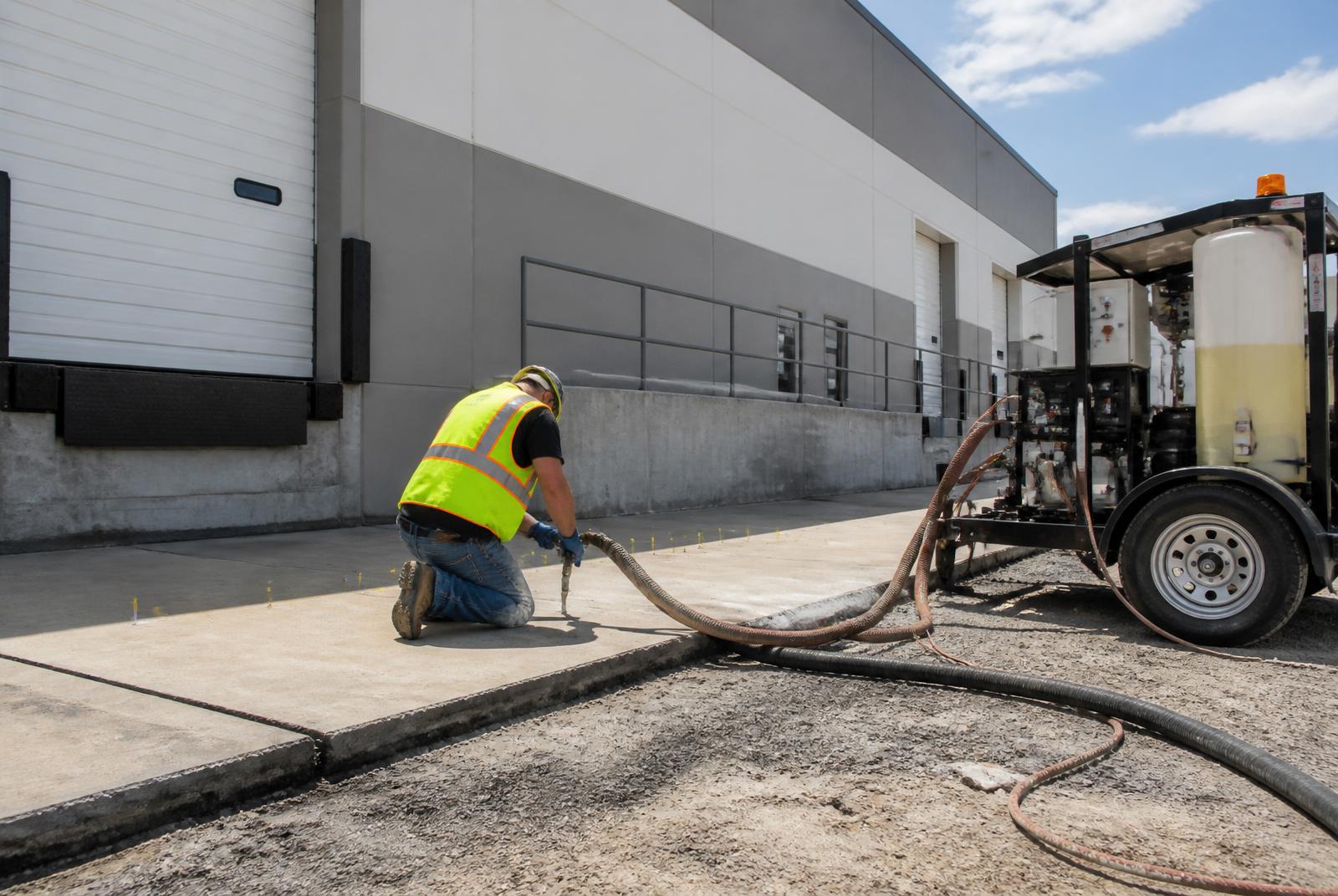
Illustrative project template. This case study documents the type of project we perform and the process we follow in this market. It is not a specific past customer's job — no customer names, testimonials, or outcomes are represented. Placeholder sections marked below will be replaced with real project photos and details as completed jobs are documented.
Local context
Spokane, WA
Representative project location: South Hill neighborhood near Manito Park.
- Nearby landmarksManito Park, Comstock Park, Rockwood Blvd
- Typical soilOlder South Hill lots typically sit on silty clay with pockets of decomposed granite — poor draining when saturated.
- DrainageMature street trees and older lawn grading routinely direct runoff toward front walks.
- Freeze/thawSouth Hill sees pronounced freeze/thaw swings that heave tree-root-shifted panels year over year.
Project overview
What this project represents.
This project is a common South Hill scenario: an established block where mature parking-strip trees have gradually lifted individual sidewalk panels. Three panels along the front walk had risen — creating trip edges of roughly 3/4 to 1-1/4 inches at the joints.
Because raised (rather than sunken) panels are involved, the fix here is not a lift — it's a controlled level of the surrounding panels to eliminate the trip edge. Polyurethane foam was used to raise the neighboring lower panels back into plane with the tree-lifted panels, restoring a smooth walking surface and eliminating the ADA-relevant trip hazard.
The problem
What the homeowner was seeing.
- Three sidewalk panels along the front walk had trip edges of 3/4 to 1-1/4 inches — a common threshold for both liability concern and ADA guidance.
- The homeowner had received a City of Spokane notice regarding the trip edges nearest the parking strip.
- Manual grinding had been attempted at one edge previously and was still visible as a rough patch that had not solved the problem.
Inspection findings
What the on-site walkthrough showed.
- Trip-edge heights measured with a straightedge and feeler gauge at every joint along the walk.
- Elevations shot with a laser to identify which panels had settled versus which had been lifted by root activity.
- Root proximity noted: a mature Norway maple in the parking strip within 4 feet of the raised panels.
Cause of settlement
Why this slab moved.
- Tree roots gradually lifted two panels closest to the parking strip over a period of years.
- The panels on the house side of the trip edges had not been lifted — they had actually settled slightly, which exaggerated the height difference at the joint.
- Freeze/thaw cycles enlarge these differentials each winter as water enters the joints and pushes the panels further apart.
See a similar issue at your property?
Get a free on-site estimate.
We'll measure the drop, check for voids, evaluate the drainage, and give an honest recommendation — including whether leveling is the right call.
Repair solution
How the slab was lifted.
- 1Rather than grinding or tearing out the raised panels — either of which risks re-lift as the root continues to grow — the sunken panels were raised back into plane with polyurethane foam.
- 2Injection ports were placed away from the root zone to avoid disturbing the tree.
- 3Foam was injected in short pulses with continuous laser monitoring; each panel was brought within 1/16 inch of the target elevation.
- 4Trip edges were eliminated across all three joints. Final walking surface was verified with a straightedge at every joint.
Why polyurethane foam was selected
The right tool for this project.
- No tear-out, so the mature street tree was not disturbed.
- Foam adds minimal load — critical near an active root system where added weight can encourage additional root uplift.
- The panels were structurally sound and only 12–14 years old. Replacement would have been wasteful.
- Same-day return to service is important for a walk used daily by the homeowner and neighbors.
Repair timeline
Start to finish.
Estimate
20–30 minute on-site walkthrough with trip-edge measurements and photos.
Scheduling
Typical residential sidewalk of this size books within 1–2 weeks.
Repair day
About 2 hours on-site total.
Return to service
Foot traffic immediately after ports were patched.
Estimated project size
Approximately 60 sq ft — three residential sidewalk panels.
Expected lifespan
The panels themselves have decades of remaining life. The lift will hold as long as the underlying subgrade is intact. Future root uplift can be addressed with additional targeted lifts as needed.
Maintenance recommendations
How to make the repair last.
- Reseal joints every 2–3 years to keep water out of the subgrade.
- Monitor the parking-strip tree root growth annually — a further trip edge may develop over time regardless of this repair.
- Consider a root barrier if additional uplift is observed in the next few years.
Project photos
Placeholders for real project imagery.
Each slot below will be replaced with a real photo from an actual completed job. Placeholder cards are clearly labeled so nothing on this page implies a fabricated outcome.
Placeholder — Before Photo
Settled slab before repair — replace with the real before photo from the completed job.
Placeholder — After Photo
Slab lifted flush after polyurethane injection — replace with the real after photo.
Placeholder — Close-up Detail
Close-up of the joint or trip edge — replace with the real close-up.
Placeholder — Injection Process
Injection port and lift in progress — replace with the real process photo.
Placeholder — Finished Result
Finished slab, cleaned and re-opened for use — replace with the real finished photo.
Frequently asked questions
Questions we hear on projects like this.
- Doesn't grinding solve trip hazards more simply?
- Grinding is fast but removes the top surface of the panel, exposing aggregate and shortening the slab's life. It also does nothing if the root continues to lift the panel — the trip edge returns. Leveling the surrounding slab is a longer-term fix.
- Will the tree root damage the repair?
- The lifted panels weren't touched, so the root has nothing new to push against. Future root growth may lift them further — if that happens, we can lift the adjacent panels again.
- Is this ADA compliant?
- The finished trip edges were under 1/4 inch across all three joints, which is within the ADA guidance for pedestrian surfaces. See our ADA sidewalk compliance page for commercial specifications.
- How did the city inspection go?
- Client-side outcomes vary. In our experience, City of Spokane trip-edge notices are considered addressed once the trip differential is eliminated — but you should always confirm with the specific inspector.
- How much would this cost?
- See our sidewalk leveling cost guide for typical Spokane pricing bands. Small residential jobs like this one are among our most affordable projects.
Related resources
Learn more before you request an estimate.
- Service · Sidewalk Leveling
- Cost Guide · Sidewalk Leveling Cost in Spokane
- Problem · Why Is My Sidewalk Creating Trip Hazards?
- Comparison · Concrete Leveling vs. Replacing a Sidewalk
- Service Area · Spokane Service Area
- Learning Center · Sidewalk Trip Hazard Liability
- Learning Center · How to Spot Trip Hazards Around Your Spokane Home
- Project Library · All Projects
- Contact · Request a Free Estimate
Free estimate — no obligation
Have a slab that looks like this?
We'll walk your property, measure the drop, and give you a written scope you can compare against any replacement bid.