Why Is My Garage Floor Sinking?
A sinking garage floor is usually not a foundation problem — the slab is floating on backfill that's compacting. Here's how to tell the difference and why leveling is almost always the right first move.
Free On-Site Estimate · Serving Spokane & the Inland Northwest
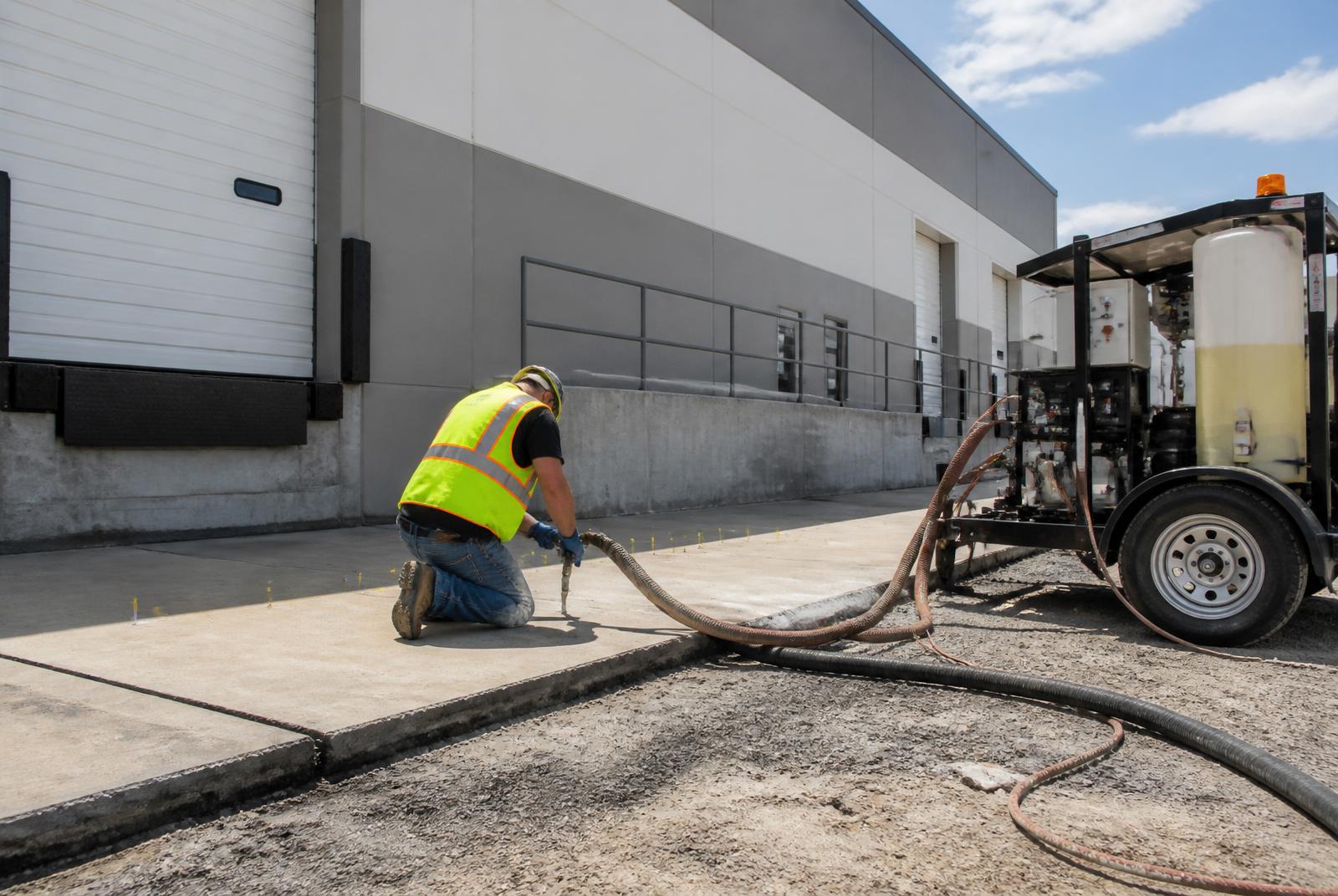
Problem overview
What's actually happening.
Almost every attached garage in Spokane sits on backfill. When the foundation was poured, the interior of the stem wall was filled with dirt and gravel, and then the floor slab was poured on top. That fill compresses for years — often decades — after the house is built.
That's why a settling garage floor is almost never a structural emergency, even though it looks alarming when a car tire drops half an inch at the same spot every time. The perimeter walls are on footings; the floor is on fill. They move independently.
The right fix restores the floor to the perimeter foundation line and stabilizes the fill so it doesn't keep dropping. Full replacement is expensive, messy, and usually unnecessary.
For the underlying service, see garage floor leveling. Serving Spokane, WA and the surrounding Inland Northwest. Ready to skip ahead? Request a free estimate.
Signs to watch for
How this problem shows up.
A gap between the garage floor and the stem wall
The floor has dropped away from the perimeter. Common along one wall or corner.
A step at the man-door threshold
The interior floor sits lower than the concrete step or slab it used to meet.
Cracks radiating from the center or one corner
The slab is flexing over an unsupported section of fill.
Doors no longer close cleanly
The garage door bottom seals unevenly, or the man door drags on one side.
A visible dip when a car is parked in the same spot
The tire footprint has become the low spot.
Water running to a corner instead of the drain
The floor slope has changed.
Common causes
Why it happens in the Inland Northwest.
Spokane's freeze/thaw cycles, clay-and-silt soils, and heavy seasonal runoff produce a fairly predictable set of root causes.
Backfill compaction
The most common cause. Fill placed at construction time has been settling ever since.
Water infiltration under the slab
Roof runoff, sump discharge, or landscape irrigation pushing water under the garage.
Poor perimeter grading
Ground outside the garage sloping toward the walls sends water through the joint at the stem wall.
Freeze/thaw of wet subgrade
Wet fill under a garage in an unheated space still cycles enough to open voids.
Original fill quality
Some homes were finished with topsoil-heavy fill instead of properly compacted gravel. It settles further, longer.
How to determine severity
Read your slab like a pro.
A quick self-triage. When in doubt, request a free on-site walkthrough.
- Under ½ inch drop, no cracks: cosmetic — worth watching, easy to lift now.
- ½–1½ inches, minor cracking: moderate. Fix before cracks widen.
- 1½–3 inches, or a visible gap at the wall: significant. Water is now getting under the slab and accelerating things.
- Slab rocks under a car tire, or you hear hollow spots when tapped: real voids are present. Level soon.
- Slab is broken into pieces that move independently: replacement territory for those pieces.
Not sure how bad it is?
Get a free walkthrough before it gets worse.
We'll measure the drop, check for voids, evaluate the drainage, and give you an honest recommendation — including whether it's a leveling job or something else.
Why waiting makes it worse
Settlement doesn't fix itself.
Every cause listed above keeps working whether or not the slab is addressed.
- Cracks widen and eventually break the slab into unsupported pieces that can't be lifted cleanly.
- Water enters through the gap at the stem wall and accelerates the settlement.
- The garage door seal fails, letting in rodents, cold air, and blown snow.
- Vehicles parked in the same spot deepen the low area as fill continues to compress.
- The lift needed grows — a job that's a few hours today may need a partial replacement in two years.
Repair options
What are your choices?
An honest comparison — the right fix depends on the slab, the cause, and the goal.
Polyurethane foam leveling
Foam injected through small holes lifts the slab and stabilizes the underlying fill. Drive on it the same day.
Mudjacking
Older method; still works but adds significant weight to weak fill, and slurry can wash out over time.
Partial replacement
Right answer for slabs broken into pieces or where a vehicle drop is severe and localized.
Full replacement
Reserved for garages with widespread structural failure — rare on residential slabs.
Why polyurethane foam usually wins
The best fit for the vast majority of Spokane slabs.
- Cures in about 15 minutes — you can drive or walk on the slab the same day.
- Closed-cell foam doesn't wash out or absorb water like sand or slurry-based methods.
- Injection holes are dime-sized, not the golf-ball ports left by mudjacking.
- Lightweight — adds roughly 4 lbs per cubic foot vs. 100+ lbs for mud slurry, so it won't re-settle weak soil.
- Stabilizes the underlying soil at the same time it lifts the slab.
For a full comparison, see polyurethane foam vs. mudjacking in the Learning Center.
When replacement may be necessary
The honest cases where leveling isn't the right call.
- The slab is crumbling, spalling apart, or shattered with structural cracks — there's no solid piece left to lift.
- The concrete is very thin (below ~3 inches) and would crack under the lift pressure.
- You're changing the layout — widening a driveway, moving a patio, adding a new pour.
- Reinforcement is severely rusted and the slab is delaminating.
More detail in concrete leveling vs. replacement.
Frequently asked questions
Straight answers from Spokane homeowners.
- Is a sinking garage floor a foundation problem?
- Usually no. The floor slab is separate from the foundation footings. Settling in the middle almost never means the house is moving.
- How much can foam lift a garage floor?
- Several inches when needed. Most residential garage lifts are in the ½ to 2-inch range.
- Can I park in the garage the same day?
- Yes. Foam reaches driving strength in about 15 minutes.
- Will the floor sink again after leveling?
- The lifted area is stabilized — foam doesn't compress. The fix lasts as long as drainage stays under control.
- Do I need to move everything out of the garage?
- Generally we need clear access to the lift zone. Most homeowners move vehicles and shift items along the walls.
- Will you have to drill through my floor?
- Small dime-sized holes, patched flush with matching material after the lift.
- How does the fix compare to replacement?
- Leveling is typically a small fraction of replacement cost, done in hours, and doesn't require removing the garage door or wall trim.
- Does this work with an epoxied or coated floor?
- Yes — injection holes are small enough that most coated floors are patched cosmetically after the lift.
Related services
Explore the services that solve this problem.
Considering budget? Garage floor leveling cost in Spokane.
Related problems
Other homeowner questions we hear.
From the Learning Center
Related reading before you request an estimate.
Free estimate — no obligation
Fix it before the next wet season.
Settlement compounds. Every rainstorm and freeze/thaw cycle makes the void bigger. Get an honest walkthrough now and know exactly what your options are.
Lift it — don't replace it.
Have questions about your concrete? Need advice? Want a free estimate? We're here to help. Concrete leveling saves the slab you already have, at a fraction of the cost of replacement.
- Often less costly and less disruptive than tear-out and replacement
- Repair before replacement when appropriate
- Modern concrete lifting methods
- Clear recommendations — no pressure, no upsells
Free Estimates · Spokane-Focused Service · Clear Recommendations