Why Are My Front Steps Settling?
Front steps are one of the first parts of a concrete entry to move. They're small, they're heavy per square foot, and they usually sit on the least-compacted fill on the property. Here's why they drop — and why lifting them almost always makes more sense than replacing them.
Free On-Site Estimate · Serving Spokane & the Inland Northwest
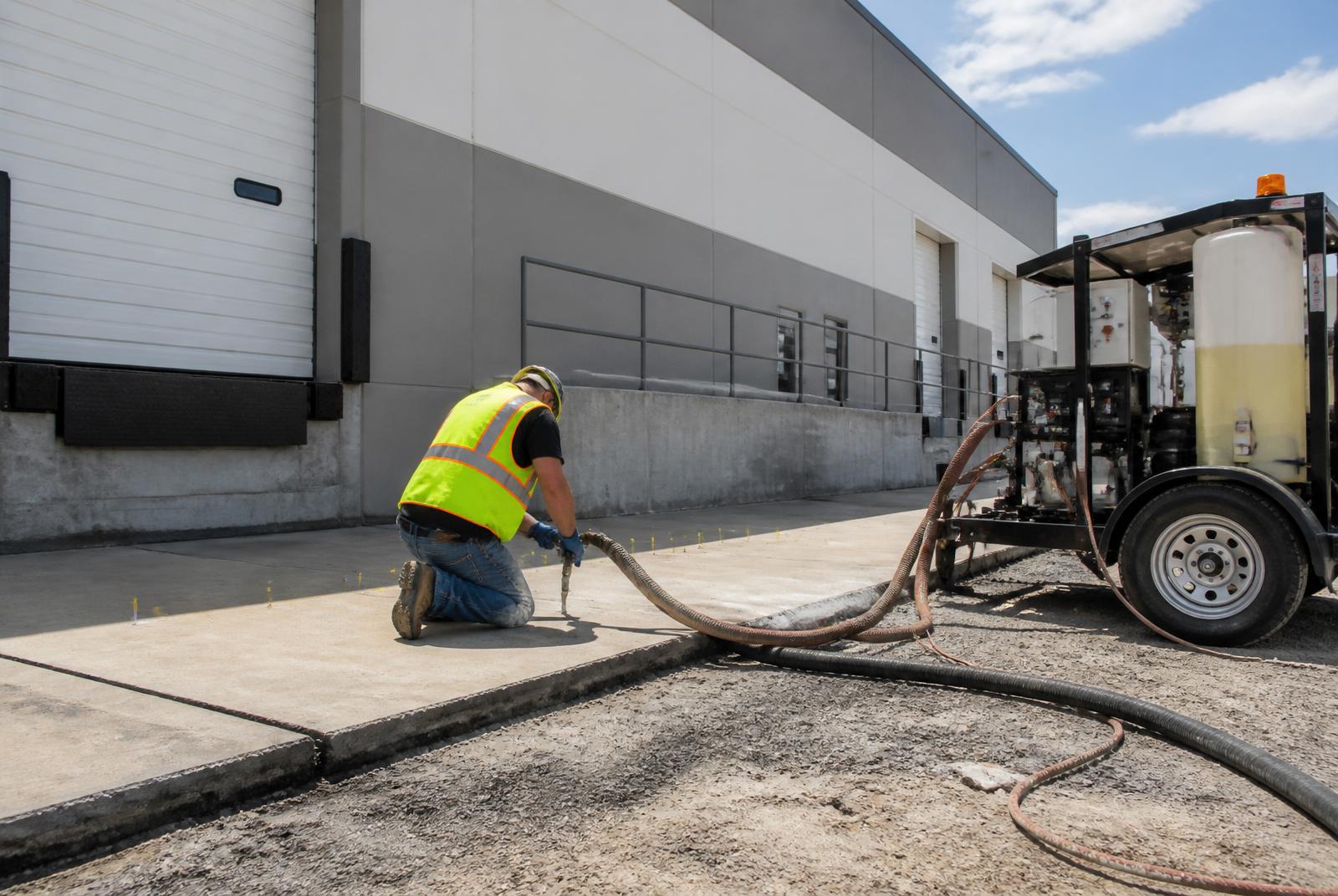
Problem overview
What's actually happening.
A concrete stair unit is essentially a hollow or partly hollow block sitting on soil at the edge of the porch. It's heavy, but its footprint is small, so any weakness in the underlying fill shows up quickly.
In Spokane, we most often see steps that have pulled a fraction of an inch away from the porch, tilted forward toward the walkway, or dropped one corner. All three are settlement, not structural failure.
Lifting a set of steps back into position — while the top tread meets the porch cleanly again — is one of the most common jobs we do in Spokane's older neighborhoods.
For the underlying service, see concrete leveling. Serving Spokane, WA and the surrounding Inland Northwest. Ready to skip ahead? Request a free estimate.
Signs to watch for
How this problem shows up.
A gap between the top step and the porch
The stairs have tipped or dropped away from the pour above.
The steps tilt forward or lean toward the walk
Front edge has dropped or the whole unit has rotated.
A trip lip at the top or bottom tread
The step-to-porch or step-to-walk transition is no longer flush.
Cracks at the step-to-porch joint
Movement is now stressing both pieces.
Water pooling on a tread
The tread is no longer sloped forward and outward as poured.
Railing tilts to one side
One side of the stair unit has dropped further than the other.
Common causes
Why it happens in the Inland Northwest.
Spokane's freeze/thaw cycles, clay-and-silt soils, and heavy seasonal runoff produce a fairly predictable set of root causes.
Backfill compaction next to the foundation
Steps sit on the same compacting fill as the porch.
Downspout discharge near the stair unit
Concentrated water erodes the fill under one side quickly.
Freeze/thaw cycling
Wet subgrade next to the concrete unit expands and contracts, opening voids.
Poor drainage from the walkway
Water running back toward the stairs undermines the front footprint.
Original fill quality
Loose fill under the stairs at construction time settles well after everything else on the property has stabilized.
How to determine severity
Read your slab like a pro.
A quick self-triage. When in doubt, request a free on-site walkthrough.
- Small gap at the porch, tread still flush: cosmetic — the easiest time to fix.
- Gap plus one tread out of level: moderate. Fix before ice makes it a fall risk.
- Trip lip at the top or bottom tread: high priority — this is where falls happen.
- Cracks running through the stair unit: the pour is now compromised. Level before it breaks apart.
- Stair unit rocking, or one side dropped significantly more than the other: prompt evaluation.
Not sure how bad it is?
Get a free walkthrough before it gets worse.
We'll measure the drop, check for voids, evaluate the drainage, and give you an honest recommendation — including whether it's a leveling job or something else.
Why waiting makes it worse
Settlement doesn't fix itself.
Every cause listed above keeps working whether or not the slab is addressed.
- Ice on a tilted tread is the most common fall pattern on residential entries.
- The gap at the porch widens and water travels toward the sill.
- Cracks widen once the unit is unsupported, and a lift becomes a partial rebuild.
- The railing angle worsens, which stresses its anchors.
- A partly settled stair unit can shift suddenly during freeze/thaw — sudden movement is when small problems become bigger ones.
Repair options
What are your choices?
An honest comparison — the right fix depends on the slab, the cause, and the goal.
Polyurethane foam leveling
Foam lifts the entire stair unit as one piece and closes the gap at the porch.
Mudjacking
Works on solid stair pours, but adds meaningful weight and requires larger holes on visible faces.
Replacement of a single tread
Occasionally right for a broken tread while the rest of the unit is fine.
Full stair replacement
Reserved for units that are cracked apart or badly spalled beyond repair.
Why polyurethane foam usually wins
The best fit for the vast majority of Spokane slabs.
- Cures in about 15 minutes — you can drive or walk on the slab the same day.
- Closed-cell foam doesn't wash out or absorb water like sand or slurry-based methods.
- Injection holes are dime-sized, not the golf-ball ports left by mudjacking.
- Lightweight — adds roughly 4 lbs per cubic foot vs. 100+ lbs for mud slurry, so it won't re-settle weak soil.
- Stabilizes the underlying soil at the same time it lifts the slab.
For a full comparison, see polyurethane foam vs. mudjacking in the Learning Center.
When replacement may be necessary
The honest cases where leveling isn't the right call.
- The slab is crumbling, spalling apart, or shattered with structural cracks — there's no solid piece left to lift.
- The concrete is very thin (below ~3 inches) and would crack under the lift pressure.
- You're changing the layout — widening a driveway, moving a patio, adding a new pour.
- Reinforcement is severely rusted and the slab is delaminating.
More detail in concrete leveling vs. replacement.
Frequently asked questions
Straight answers from Spokane homeowners.
- Can foam lift a whole set of steps?
- Yes. The stair unit is lifted as one piece, back to meet the porch cleanly.
- Will the railing have to come off?
- Usually not. Lifting is done around the existing hardware.
- How much can you lift?
- Fractions of an inch to several inches. Most residential front steps are in the ½ to 1½ inch range.
- How long until we can use the steps?
- Immediately — within 15 to 30 minutes after the lift.
- Is a gap at the porch a foundation issue?
- Almost never. The steps and the house move independently; the gap is settlement, not structure.
- What if a tread is cracked?
- If the crack is stable and the pieces still align, the lift often closes it. If the tread is broken through, that piece may need to be replaced.
- Do you fix steps on rentals and HOAs?
- Yes — see our commercial and HOA sidewalk repair pages for scope.
- Do you serve Post Falls and Coeur d'Alene?
- Yes — front step leveling throughout the Inland Northwest.
Related services
Explore the services that solve this problem.
Related problems
Other homeowner questions we hear.
From the Learning Center
Related reading before you request an estimate.
Free estimate — no obligation
Fix it before the next wet season.
Settlement compounds. Every rainstorm and freeze/thaw cycle makes the void bigger. Get an honest walkthrough now and know exactly what your options are.
Lift it — don't replace it.
Have questions about your concrete? Need advice? Want a free estimate? We're here to help. Concrete leveling saves the slab you already have, at a fraction of the cost of replacement.
- Often less costly and less disruptive than tear-out and replacement
- Repair before replacement when appropriate
- Modern concrete lifting methods
- Clear recommendations — no pressure, no upsells
Free Estimates · Spokane-Focused Service · Clear Recommendations