Mudjacking vs. PolyLevel®.
PolyLevel® is a brand name for a two-component polyurethane concrete-leveling foam. This page compares it — and other high-density foam systems — to traditional cement-slurry mudjacking on a Spokane home.
Free On-Site Estimate · Serving Spokane & the Inland Northwest
Overview
What we're actually comparing.
PolyLevel® is a trademarked branded formulation of the same category as other high-density polyurethane concrete-lifting foams. Comparing 'mudjacking vs. PolyLevel®' is essentially comparing mudjacking to polyurethane foam lifting as a category — the branded product behaves like other quality foam systems.
We aren't a PolyLevel® dealer. We use professional-grade polyurethane systems that meet the same technical specifications. This page is written to help Spokane homeowners understand the underlying method comparison so you can make a good decision whichever contractor you hire.
For the underlying service, see concrete leveling. Serving Spokane, WA and the surrounding Inland Northwest. Ready to skip to a real recommendation? Request a free estimate.
The two options
A plain-English look at each method.
Mudjacking
Cement/sand/water slurry pumped through 1–1.5" ports to lift the slab.
Mudjacking is the original slab-lifting method — a mechanical pump forces a heavy slurry beneath the concrete until it rises. The slurry cures over the following hours as an aggregate mass beneath the slab.
It's a proven approach for very heavy commercial slabs. On residential Spokane homes, its main drawbacks are weight, cure time, port size, and how the material behaves in wet or freeze-thaw soils.
PolyLevel® / High-Density Polyurethane Foam
A two-part expanding closed-cell foam injected through 5/8" ports.
PolyLevel® is a branded high-density polyurethane concrete leveling foam. The chemistry, application method, and homeowner experience are functionally equivalent to other professional-grade polyurethane lifting foams on the market.
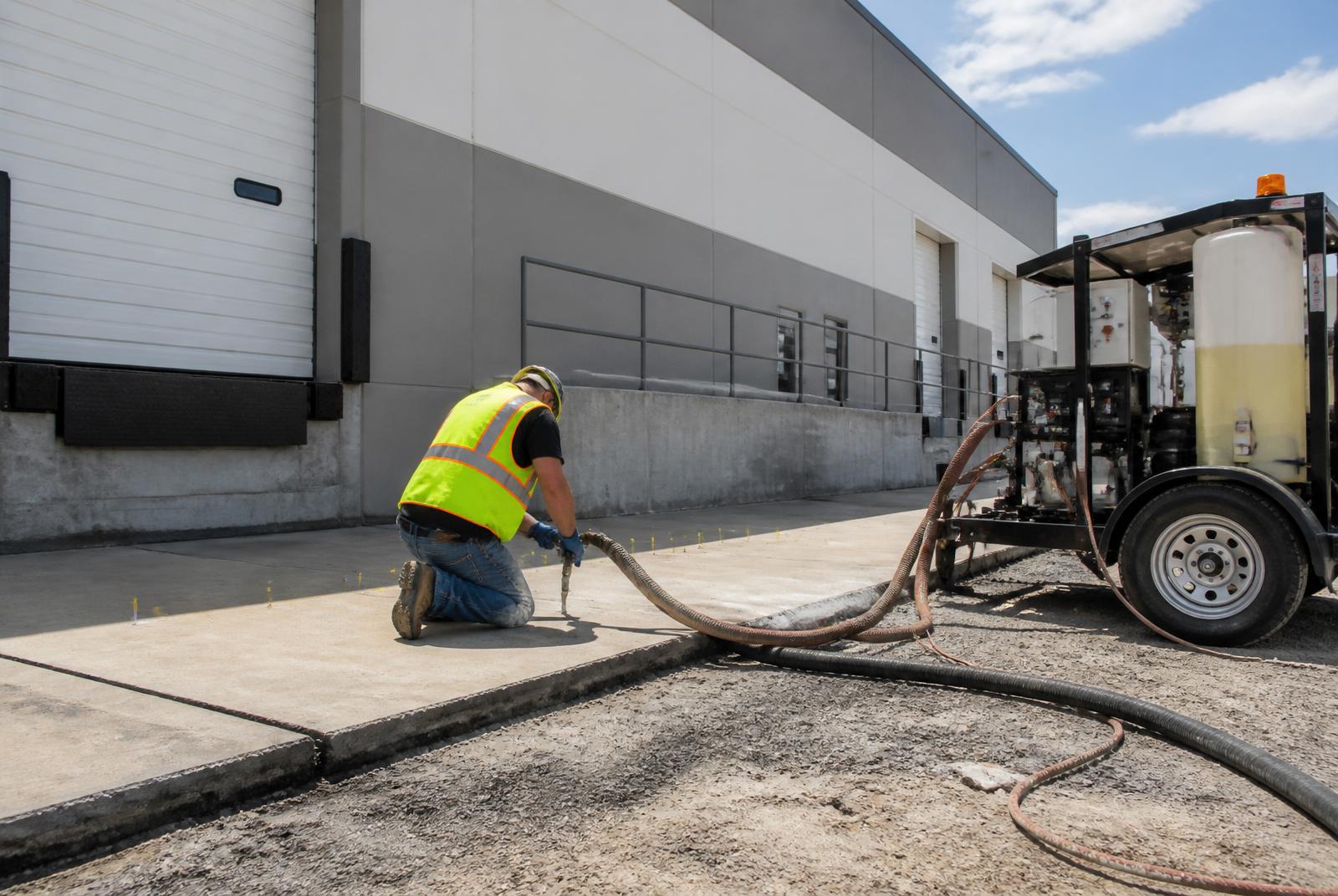
The foam expands, lifts, and cures in about 15 minutes. The lift is dimensionally stable, water-insensitive, and typically warrantied for 5–10 years on residential work.
Pros and cons
Honest tradeoffs for each option.
Mudjacking
Pros
- Longstanding, well-understood method with a long track record.
- Lower material cost per cubic foot in isolation.
- Wide availability — many general contractors offer it.
Cons
- Heavy — can accelerate re-settlement in soft or wet soils.
- Long cure time compared to foam.
- Larger port holes are more visible on decorative concrete.
PolyLevel® / High-Density Polyurethane Foam
Pros
- Fast cure (~15 minutes) and same-day return to service.
- Water-insensitive — doesn't erode or wash out.
- Small (5/8") ports leave a much less visible finish.
- Adds negligible weight to the subgrade.
- Branded formulations like PolyLevel® come with well-documented product data sheets.
Cons
- Higher per-square-foot material cost in isolation.
- Fewer installers in any given market — the equipment is specialty.
- Branded product doesn't automatically mean better installation — installer skill still matters most.
Side by side
Cost, time, lifespan, warranty — one table.
Ranges reflect typical Spokane residential projects. Every real number comes from an on-site walkthrough.
| Factor | Mudjacking | PolyLevel® / High-Density Polyurethane Foam |
|---|---|---|
| Cost (typical Spokane residential) | $500 – $1,800 | $700 – $2,500 |
| Time on site | 2–5 hours | 1–3 hours |
| Disruption | Golf-ball ports; overnight cure for vehicles | Dime-sized ports; back in service same day |
| Expected lifespan | 5–10 years in wet soil | 20+ years with drainage addressed |
| Warranty | 1–5 years | 5–10 years, often transferable |
| Maintenance | Watch for erosion re-settlement | Standard joint sealing, drainage upkeep |
| Environmental impact | Cement-heavy; more material by weight | Less material by weight; no demolition |
| Best application | Very heavy commercial slabs with dry, stable subgrades | Residential slabs in the Inland Northwest |
Spokane climate & soil
Freeze/thaw, clay soils, and drainage.
Spokane's clay-and-silt soils and long snowmelt season are hard on any cement-based lift material. Any high-density polyurethane foam — whether it's branded PolyLevel® or a comparable professional system — is designed exactly for this kind of moisture-heavy subgrade.
If a Spokane contractor tries to sell you PolyLevel® over mudjacking, the reasoning behind that recommendation should be the same regardless of which brand of foam ends up in the injector.
Environmental impact
Which option is easier on the environment?
Polyurethane systems generally use far less material by weight than mudjacking slurry for the same lift. There's no demo debris in either method, but foam avoids the embodied carbon of the cement in mudjacking slurry.
Best use cases
When each option genuinely fits.
Best for Mudjacking
- Heavy commercial floor slabs with stable, dry subgrades.
- Rural or infrastructure lifts where cosmetics don't matter.
- Budget-driven jobs where longevity in wet soil isn't the priority.
Best for PolyLevel® / High-Density Polyurethane Foam
- Any residential driveway, sidewalk, patio, garage floor, or pool deck in the Spokane market.
- Slabs adjacent to downspouts, sprinklers, or persistent moisture.
- Decorative or stamped concrete where port size is a real concern.
When concrete leveling is the better call
Signals that lifting wins.
- The slab is structurally sound but has moved.
- You value quick return-to-service and long warranty.
- You're evaluating branded foam options — the category benefits apply broadly.
Not sure which one fits your slab?
We'll give you an honest recommendation.
We come out, walk the slab, and tell you which method (or replacement) is the right buy — even when it isn't a job for us.
When replacement is honestly better
The cases where lifting isn't the right call.
- Slab is spalled, crumbling, or full-depth cracked.
- The base under the slab was never built properly and needs a redo.
- You want to change the footprint or grade of the flatwork.
Frequently asked questions
Straight answers from Spokane homeowners.
- Is PolyLevel® better than other polyurethane foams?
- It's a well-documented product from a national brand. Other professional-grade polyurethane foams meet similar specifications. Installer skill and honest project scoping matter more than the label on the drum.
- Do I need to hire a PolyLevel® dealer specifically?
- No. A qualified concrete-leveling contractor using a comparable high-density polyurethane will give you the same category of result. Compare warranty terms and reviews, not just brand names.
- How is PolyLevel® applied?
- The contractor drills 5/8" ports, injects the two-part resin, and lets it expand to lift the slab. Cure time is around 15 minutes; the ports are patched with a color-matched grout.
- Which lasts longer — mudjacking or foam?
- In the Inland Northwest's wet soils, high-density foam consistently outperforms mudjacking on longevity because it doesn't absorb water.
- Can PolyLevel® fix cracks?
- No — it lifts the slab. Existing cracks stay. See [can cracked concrete be leveled](/learning-center/concrete-problems/can-cracked-concrete-be-leveled).
- How much does a branded foam system cost vs. generic mudjacking?
- Expect roughly 20–40% more for a foam lift than mudjacking on the same square footage, though final cost depends more on lift height and access than on brand.
- Is PolyLevel® safe around plants and pets?
- Yes, once cured. The chemistry cures into an inert closed-cell foam. Follow the installer's guidance during application and cure time.
- How do I know which method is actually right for my slab?
- Request a free on-site walkthrough — we measure the settlement, check the subgrade and drainage, and recommend the method (or replacement) that fits your specific slab.
Related services
Explore the services this comparison touches.
Keep researching
Related pricing, problem pages, and articles.
Homeowner problems
Serving Spokane and the surrounding Inland Northwest. Prefer to skip the reading? Request a free estimate.
Free estimate — no obligation
Get an honest recommendation for your slab.
Ranges are useful. A real recommendation is better. We come out, evaluate the slab, and tell you which method — or whether replacement — is actually the right buy.
Lift it — don't replace it.
Have questions about your concrete? Need advice? Want a free estimate? We're here to help. Concrete leveling saves the slab you already have, at a fraction of the cost of replacement.
- Often less costly and less disruptive than tear-out and replacement
- Repair before replacement when appropriate
- Modern concrete lifting methods
- Clear recommendations — no pressure, no upsells
Free Estimates · Spokane-Focused Service · Clear Recommendations