Concrete repair vs. concrete replacement.
Not every problem calls for a tear-out. Not every crack is fine to leave. This is a plain-English framework for figuring out whether your concrete needs a repair — lift, seal, patch — or an actual replacement.
Free On-Site Estimate · Serving Spokane & the Inland Northwest
Overview
What we're actually comparing.
'Repair' covers a lot of ground: leveling a settled slab, sealing joints, patching spalled edges, filling cracks, resurfacing. 'Replacement' is exactly what it sounds like — demolish and re-pour.
The right call almost always comes down to whether the concrete itself is structurally sound. If the slab is intact but has moved, repair. If the slab is falling apart, replace.
For the underlying service, see concrete leveling. Serving Spokane, WA and the surrounding Inland Northwest. Ready to skip to a real recommendation? Request a free estimate.
The two options
A plain-English look at each method.
Concrete Repair
Targeted fixes that keep the existing slab in service.
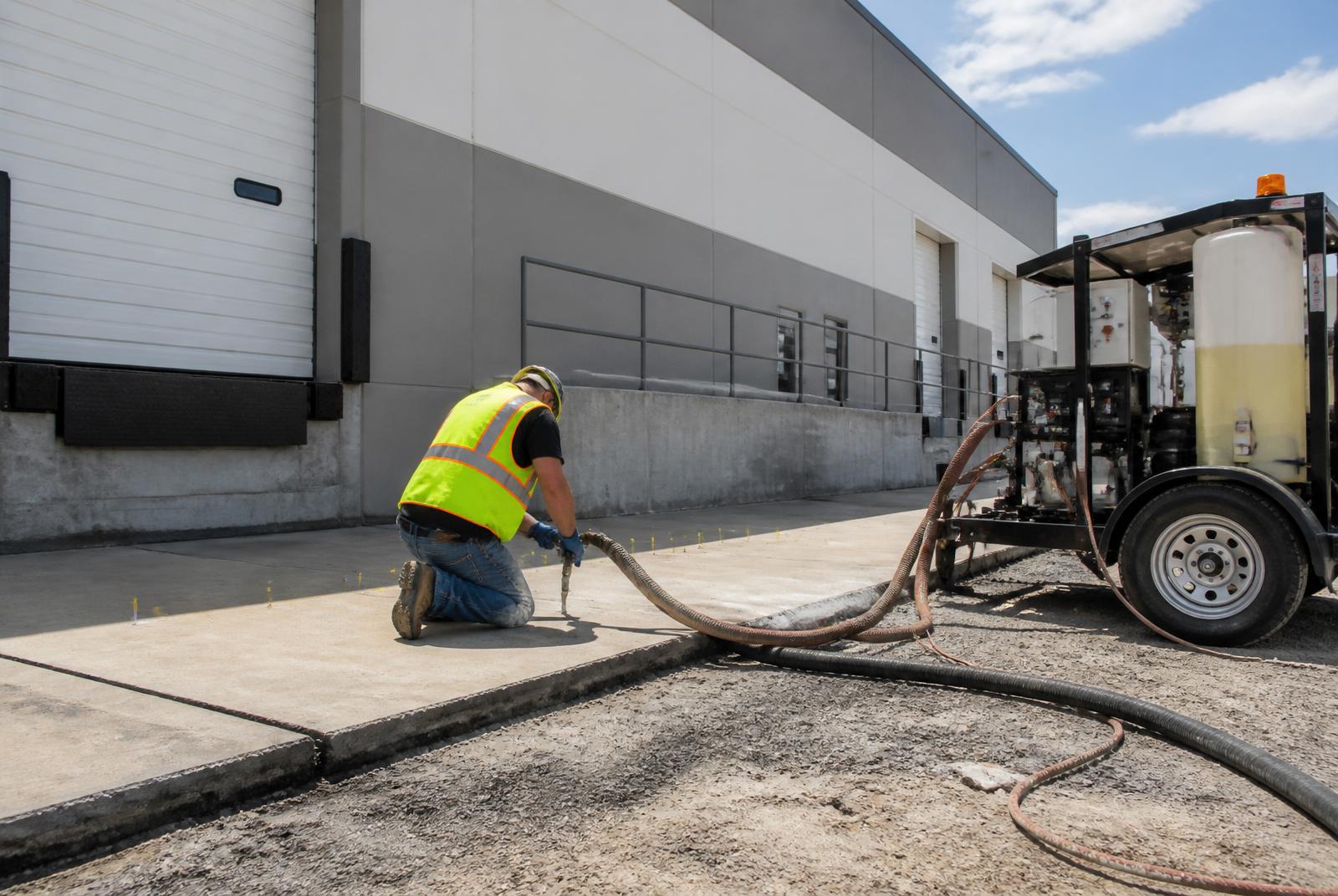
Repair covers leveling, joint sealing, crack repair, edge patching, and resurfacing. For most Spokane homeowners, the biggest repair category is leveling — lifting a settled slab back to grade with polyurethane foam.
Repair is fastest, cheapest, and least disruptive. It's also honest — if a slab isn't a candidate, we say so.
Concrete Replacement
Full demolition and re-pour of the slab.
Replacement is a bigger project: demolish the existing slab, haul the debris off, prepare the subgrade, place forms and rebar, pour and finish new concrete, and cure it.
It's the right call when the concrete itself is compromised — spalled, crumbling, structurally cracked, or too thin to lift.
Pros and cons
Honest tradeoffs for each option.
Concrete Repair
Pros
- Fraction of the cost of replacement for most residential slabs.
- Same-day or same-week completion.
- No landscaping damage.
- Preserves the existing color, texture, and age match.
Cons
- Doesn't fix concrete that's fundamentally failed.
- Won't reset the appearance of an old, weathered slab.
Concrete Replacement
Pros
- Fully resets the slab's condition.
- Chance to fix base, drainage, and reinforcement issues.
- Longer new-slab warranty on the concrete itself.
Cons
- Multiples of the cost of repair on the same footprint.
- Long return-to-service (days to weeks).
- Collateral damage to adjacent landscaping and hardscape.
- Doesn't automatically address the underlying soil cause.
Side by side
Cost, time, lifespan, warranty — one table.
Ranges reflect typical Spokane residential projects. Every real number comes from an on-site walkthrough.
| Factor | Concrete Repair | Concrete Replacement |
|---|---|---|
| Cost (Spokane residential) | $400 – $2,500 | $3,000 – $12,000+ |
| Time on site | Hours | Days |
| Disruption | Low | High |
| Expected lifespan | 10–25+ years | 25–40 years |
| Warranty | Depends on scope; foam lift 5–10 years | 1–5 years on concrete |
| Maintenance | Standard sealing, drainage upkeep | Same maintenance profile |
| Environmental impact | Low — no demo, minimal new material | High — demolition + new cement |
| Best application | Structurally sound slabs that have moved or cracked cosmetically | Failed concrete — spalled, crumbling, or structurally cracked |
Spokane climate & soil
Freeze/thaw, clay soils, and drainage.
Spokane's freeze/thaw exposes a lot of cosmetic damage on healthy slabs — hairline cracks, popcorned surfaces, joint separation. Most of it is a repair conversation, not a replacement one.
The exception is heavily de-iced concrete near garages and entryways. Repeated exposure to melt chemicals can cause deep spalling that no lift or patch will fix.
Environmental impact
Which option is easier on the environment?
Concrete has one of the highest embodied-carbon footprints per pound of any residential building material. Repairing rather than replacing keeps that concrete out of the landfill and avoids a fresh pour. When replacement is truly necessary, it's necessary — but 'repair when reasonable' is the greener default.
Best use cases
When each option genuinely fits.
Best for Concrete Repair
- Slab has settled or tilted but is otherwise intact.
- Hairline or joint cracks in a structurally healthy slab.
- Trip hazards between sidewalk sections.
- Pool deck, patio, or garage floor with soft spots or minor cracking.
Best for Concrete Replacement
- Slab is spalled, crumbling, or reinforcement has failed.
- Cracks are structural and running through the full slab.
- The slab is too thin to lift or too old to reasonably repair.
- You want to reconfigure the flatwork's shape or grade.
When concrete leveling is the better call
Signals that lifting wins.
- The concrete is basically sound and only the ground shifted.
- You need the surface back in service quickly.
- Budget matters and the slab has decades of life left.
Not sure which one fits your slab?
We'll give you an honest recommendation.
We come out, walk the slab, and tell you which method (or replacement) is the right buy — even when it isn't a job for us.
When replacement is honestly better
The cases where lifting isn't the right call.
- The concrete itself is failed at the material level.
- The base needs to be rebuilt from scratch.
- You're changing the layout or size of the flatwork.
Frequently asked questions
Straight answers from Spokane homeowners.
- Is repair always cheaper than replacement?
- For any given comparable slab, yes — meaningfully. The question is whether repair is technically appropriate.
- How do I know if my slab is 'structurally sound'?
- Look for full-depth cracks, edges you can crumble in your hand, or reinforcement showing through the surface. Any of those and you're in replacement territory. A quick on-site walkthrough can tell you for sure.
- Can I do partial replacement?
- Yes — sections of sidewalk and driveway are often replaced individually while others are leveled. It's a common hybrid approach in Spokane.
- Do repairs affect the resale value?
- Not negatively — a professionally leveled slab is generally viewed as a home in good repair. See [can uneven concrete affect your home's value](/learning-center/homeowner-guides/can-uneven-concrete-affect-your-homes-value).
- How long does a concrete repair last?
- Foam leveling on a stable soil profile typically outlasts a 20+ year window. Sealing and patching are shorter-term but low-cost.
- When is replacement actually cheaper long-term?
- When the concrete itself is nearing end-of-life — you're patching a slab that's going to need replacement in a few years anyway.
- Will an honest contractor tell me to replace?
- Yes — and if a contractor pitches leveling on a clearly-failed slab, that's your cue to get a second opinion.
- How do I get an honest recommendation?
- Request a free on-site walkthrough. We evaluate the concrete, measure the settlement, and give a written recommendation — including 'this should be replaced' when that's the honest call.
Related services
Explore the services this comparison touches.
Keep researching
Related pricing, problem pages, and articles.
Homeowner problems
Serving Spokane and the surrounding Inland Northwest. Prefer to skip the reading? Request a free estimate.
Free estimate — no obligation
Get an honest recommendation for your slab.
Ranges are useful. A real recommendation is better. We come out, evaluate the slab, and tell you which method — or whether replacement — is actually the right buy.
Lift it — don't replace it.
Have questions about your concrete? Need advice? Want a free estimate? We're here to help. Concrete leveling saves the slab you already have, at a fraction of the cost of replacement.
- Often less costly and less disruptive than tear-out and replacement
- Repair before replacement when appropriate
- Modern concrete lifting methods
- Clear recommendations — no pressure, no upsells
Free Estimates · Spokane-Focused Service · Clear Recommendations