Driveway Leveling — Spokane Valley, WA
A representative Spokane Valley driveway project showing how a settled apron slab was lifted back to grade with polyurethane foam in a single half-day visit.
Representative Project · Serving the Inland Northwest
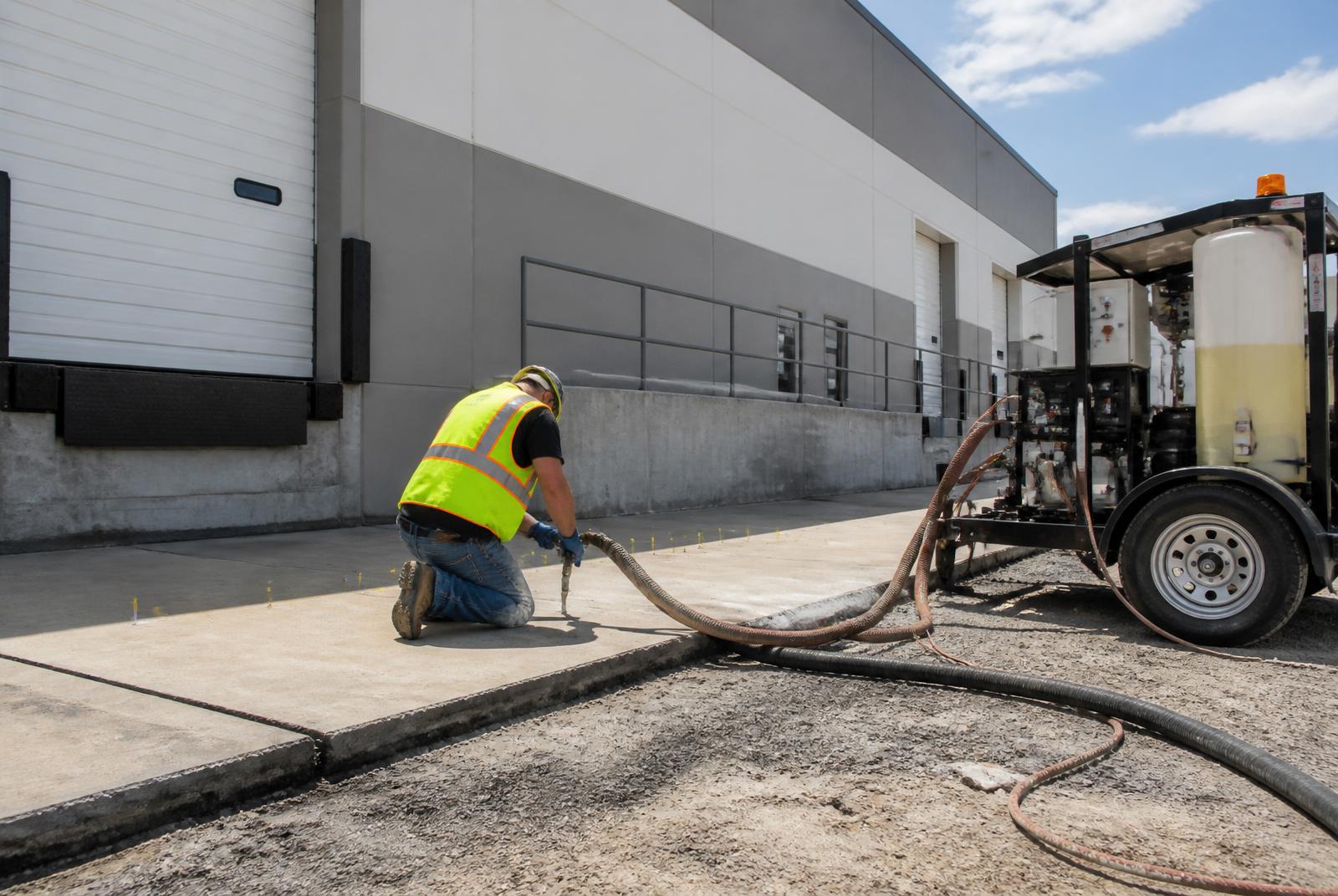
Illustrative project template. This case study documents the type of project we perform and the process we follow in this market. It is not a specific past customer's job — no customer names, testimonials, or outcomes are represented. Placeholder sections marked below will be replaced with real project photos and details as completed jobs are documented.
Local context
Spokane Valley, WA
Representative project location: near Sullivan Rd and 4th Ave.
- Nearby landmarksSpokane Valley Mall, Plantes Ferry Park, Centennial Trail
- Typical soilSilt-loam over glacial outwash gravel, common through the Spokane Valley aquifer corridor.
- DrainageRoof runoff and driveway sheet flow that historically shed toward the garage apron.
- Freeze/thaw70+ freeze/thaw cycles per winter in the Valley expand any subgrade voids year after year.
Project overview
What this project represents.
This case study documents the type of driveway settlement we see routinely in Spokane Valley: two apron panels dropping 1–1.5 inches at the garage door with a lip forming at the transition. The homeowner had planned a full tear-out replacement, then requested a leveling estimate after a neighbor's project.
Polyurethane foam injection was selected because the concrete itself was structurally sound — no shattered panels, no rebar exposure — and the drop was consistent with subgrade washout, not slab failure. The panels were lifted flush and traffic-ready the same day.
The problem
What the homeowner was seeing.
- The two apron panels closest to the garage had settled 1–1.5 inches at the door, creating a visible lip and a hollow sound when tapped.
- Water sheeting off the driveway during rain was ponding at the door threshold and draining under the slab instead of off the property.
- Hairline cracks had opened at the control joints as the panels tilted independently from the neighboring slab.
Inspection findings
What the on-site walkthrough showed.
- Elevations measured with a laser level at 12-inch intervals across the affected panels and adjacent stable slabs.
- Drop confirmed at 1-3/8 inches maximum at the garage-side edge, tapering to 3/8 inch at the far corner.
- Void mapping with a probe rod at joint edges — voids detected 2–4 inches below the slab across most of the two affected panels.
- Drainage inspection: two downspouts within 6 feet of the settled panels discharging directly onto the driveway.
Cause of settlement
Why this slab moved.
- Silt-loam subgrade beneath the apron was saturated repeatedly by roof runoff from the downspouts nearest the garage.
- Freeze/thaw cycles then expanded the wet subgrade and left voids as the soil consolidated during dry periods.
- The garage foundation stayed put on its footing while the driveway apron — sitting on a shallower prepared subgrade — dropped into the developing void.
See a similar issue at your property?
Get a free on-site estimate.
We'll measure the drop, check for voids, evaluate the drainage, and give an honest recommendation — including whether leveling is the right call.
Repair solution
How the slab was lifted.
- 1Small (5/8-inch) injection ports were drilled through the affected panels along a grid, staying clear of control joints and the garage-side edge.
- 2Two-component polyurethane foam was injected in staged lifts, filling the void first and then applying controlled lift pressure to bring the slab back to grade.
- 3Elevations were monitored with the laser at every stage; injection stopped as soon as each measurement point returned to within 1/8 inch of the target elevation.
- 4Ports were patched flush with color-matched cement. The homeowner drove on the apron the same afternoon.
Why polyurethane foam was selected
The right tool for this project.
- The concrete was structurally sound — replacement would have discarded good slab.
- Polyurethane foam cures in about 15 minutes, so the driveway was traffic-ready the same day rather than the 5–7 days a replacement cures.
- Foam is roughly 1/40th the weight of the mudjacking slurry alternative, so it doesn't reload the same soft subgrade that failed in the first place.
- Closed-cell foam is hydrophobic — future roof runoff won't wash it out the way it washed out the original subgrade.
- No excavation meant no landscape, sprinkler, or curb damage.
Repair timeline
Start to finish.
Estimate
On-site walkthrough, laser measurements, void probing, and written scope — under 30 minutes.
Scheduling
Typical Spokane Valley driveway of this size books within 1–2 weeks depending on season.
Repair day
Roughly 3–4 hours on-site: drill, inject, verify elevation, patch, and clean.
Return to service
Foot traffic immediately. Vehicles once ports are patched — same day.
Estimated project size
Approximately 200 sq ft across two settled apron panels.
Expected lifespan
Polyurethane foam does not decompose or wash out. With the drainage corrected, this style of lift routinely holds for the remaining life of the slab (commonly 20+ years).
Maintenance recommendations
How to make the repair last.
- Extend or redirect the two garage-side downspouts a minimum of 4 feet away from the driveway apron.
- Reseal control joints every 2–3 years to keep surface water out of the subgrade.
- Re-check elevations after the first full freeze/thaw season and again after any major landscape irrigation change.
Project photos
Placeholders for real project imagery.
Each slot below will be replaced with a real photo from an actual completed job. Placeholder cards are clearly labeled so nothing on this page implies a fabricated outcome.
Placeholder — Before Photo
Settled slab before repair — replace with the real before photo from the completed job.
Placeholder — After Photo
Slab lifted flush after polyurethane injection — replace with the real after photo.
Placeholder — Close-up Detail
Close-up of the joint or trip edge — replace with the real close-up.
Placeholder — Injection Process
Injection port and lift in progress — replace with the real process photo.
Placeholder — Finished Result
Finished slab, cleaned and re-opened for use — replace with the real finished photo.
Frequently asked questions
Questions we hear on projects like this.
- How long did the actual lift take?
- The lift portion — from first port drilled to final elevation confirmed — was under two hours on a driveway this size. Total on-site time including patching and cleanup was 3–4 hours.
- Was traffic allowed the same day?
- Yes. Polyurethane foam reaches roughly 90% of its cure strength within 15 minutes. Vehicles were back on the apron the same afternoon after patches set.
- Why not just tear out and replace the apron?
- Replacement was the homeowner's first plan and would have worked — but it discards structurally sound concrete, requires 5–7 days of cure time, and does nothing to fix the drainage issue that caused the settlement. Leveling plus drainage correction addresses the actual cause at a fraction of the disruption.
- Will the panels settle again?
- Not from the same cause once the downspouts were redirected. Polyurethane foam doesn't wash out or decompose, and the drainage fix removes the water that created the original void.
- Does the repair change how the driveway looks?
- Slightly — the injection ports are visible as color-matched dime-sized patches. From standing height they're difficult to see, and they don't affect anything structurally.
- Would this work for a driveway with cracked panels?
- Sometimes. Hairline settlement cracks like this driveway had close back up when the slab is lifted. Wide, shattered, or spalling cracks need to be evaluated case-by-case — see our comparison guide on leveling vs. replacing a driveway.
Related resources
Learn more before you request an estimate.
- Service · Driveway Leveling
- Cost Guide · Driveway Leveling Cost in Spokane
- Problem · Why is my driveway sinking?
- Comparison · Concrete Leveling vs. Replacing a Driveway
- Service Area · Spokane Valley Service Area
- Learning Center · Why Concrete Sinks in Spokane
- Learning Center · Polyurethane Foam vs. Mudjacking
- Project Library · All Projects
- Contact · Request a Free Estimate
Free estimate — no obligation
Have a slab that looks like this?
We'll walk your property, measure the drop, and give you a written scope you can compare against any replacement bid.