Modern foam vs. traditional mudjacking.
This is the practical, homeowner-facing version of the mudjacking vs. foam decision — with the Spokane climate baked in.
Free On-Site Estimate · Serving Spokane & the Inland Northwest
Overview
What we're actually comparing.
Traditional mudjacking has been the default for so long that many homeowners still think it's the only option. Polyurethane foam has been the mainstream modern alternative for two decades and has taken over most of the residential Spokane market.
This page is aimed squarely at a homeowner making a real decision — what will actually happen at your house, what it'll cost, and how long it will last in the Inland Northwest.
For the underlying service, see concrete leveling. Serving Spokane, WA and the surrounding Inland Northwest. Ready to skip to a real recommendation? Request a free estimate.
The two options
A plain-English look at each method.
Traditional Mudjacking
Cement slurry pumped through larger ports.
Traditional mudjacking is the older method — a wet cement/sand slurry is pumped beneath the slab under pressure. It works, it's proven, and it's still occasionally the right call for very heavy commercial slabs on stable subgrades.
For a Spokane residential driveway or sidewalk, the tradeoffs — weight, cure time, port size, and water performance — are usually enough to tip the scales toward foam.
Polyurethane Foam
Modern high-density expanding foam through small ports.
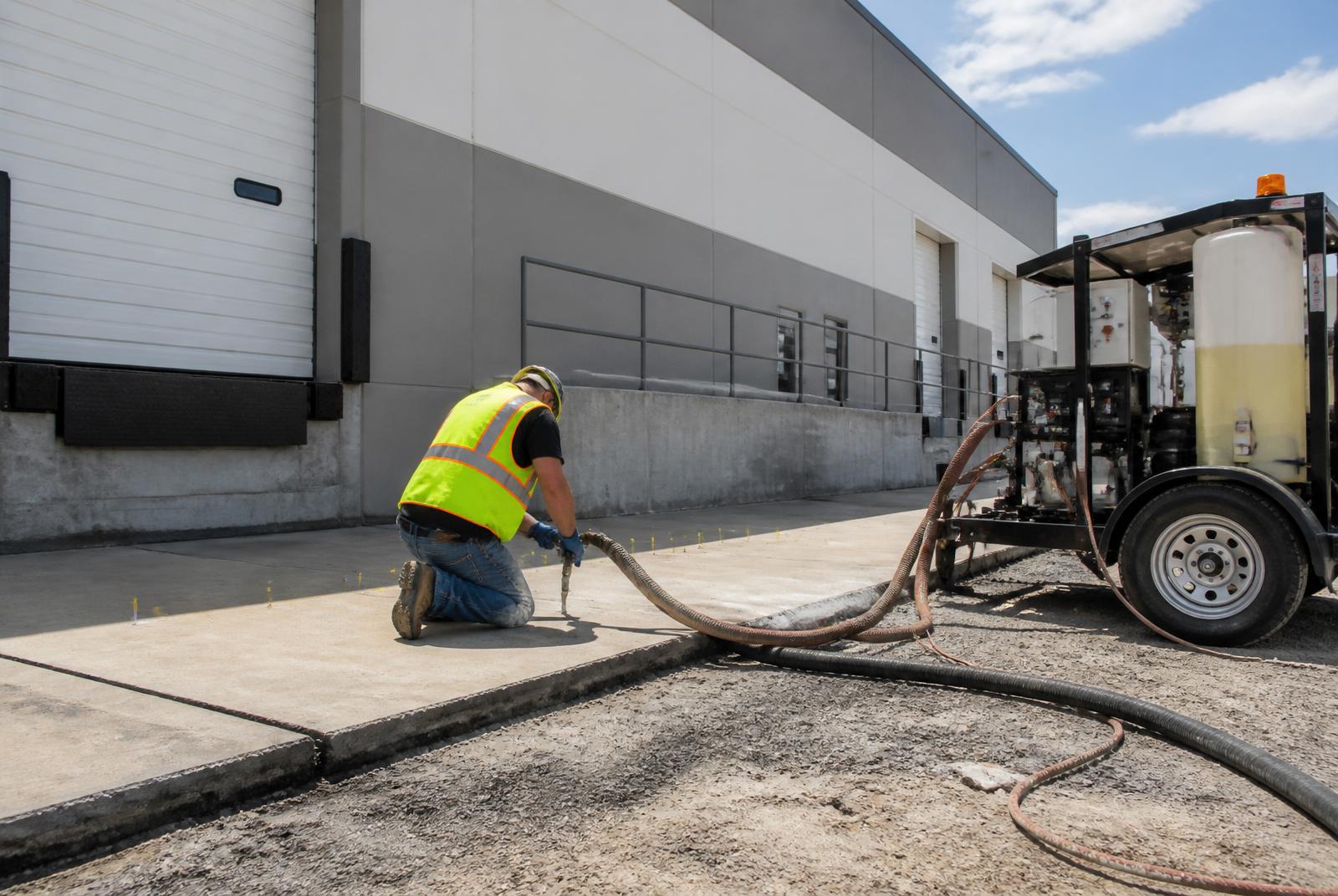
Two-part polyurethane resin is injected through 5/8" ports and reacts to form a closed-cell foam that expands and lifts the slab in real time. Cure is under 15 minutes.
The foam is water-neutral, extremely lightweight, and dimensionally stable — the material properties that make it well-suited to Spokane's soils.
Pros and cons
Honest tradeoffs for each option.
Traditional Mudjacking
Pros
- Long history and wide contractor availability.
- Lower material cost per cubic foot in isolation.
- Effective on heavy commercial slabs.
Cons
- Larger port holes visible on the surface.
- Slurry can wash out and erode over years in wet Spokane soils.
- Long cure time before full loading.
- Adds weight to already-weak subgrades.
Polyurethane Foam
Pros
- Same-day return to service.
- Small ports and clean finish.
- Water-neutral and freeze-thaw stable.
- Longer typical warranty.
- Doesn't overload the underlying soil.
Cons
- Higher per-square-foot material cost.
- Requires specialty two-part injection equipment and trained operators.
Side by side
Cost, time, lifespan, warranty — one table.
Ranges reflect typical Spokane residential projects. Every real number comes from an on-site walkthrough.
| Factor | Traditional Mudjacking | Polyurethane Foam |
|---|---|---|
| Cost (Spokane residential) | $500 – $1,800 | $700 – $2,500 |
| Time on site | 2–5 hours | 1–3 hours |
| Disruption | Overnight cure typical for vehicles | Back in service same day |
| Expected lifespan | 5–10 years typical here | 20+ years |
| Warranty | 1–5 years | 5–10 years, often transferable |
| Maintenance | Watch for re-settlement | Standard joint sealing |
| Environmental impact | Cement-heavy | Less material by weight |
| Best application | Heavy commercial slabs on stable subgrades | Residential Spokane slabs |
Spokane climate & soil
Freeze/thaw, clay soils, and drainage.
The core reason foam has won the Spokane residential market isn't marketing — it's that the local soils and freeze/thaw cycle are unusually harsh on cement-based lift material.
Foam's water-neutral chemistry is the exact property that a slab sitting on Spokane clay needs to keep the lift stable through spring melt and fall rain.
Environmental impact
Which option is easier on the environment?
The environmental math continues to favor foam per project: less material by weight, no demolition, and no cement in the lift itself. Neither approach is 'green' in an absolute sense.
Best use cases
When each option genuinely fits.
Best for Traditional Mudjacking
- Very heavy industrial slabs on well-drained subgrades.
- Contexts where cure time and port size don't matter.
Best for Polyurethane Foam
- Residential driveways, sidewalks, patios, garage floors, pool decks in Spokane.
- Slabs adjacent to downspouts, sprinklers, or wet clay.
- Decorative or stamped concrete.
- Homeowners who need the surface back in service the same day.
When concrete leveling is the better call
Signals that lifting wins.
- The concrete itself is sound.
- You want a modern method with a modern warranty.
- Spokane-specific soil and drainage conditions are part of the problem.
Not sure which one fits your slab?
We'll give you an honest recommendation.
We come out, walk the slab, and tell you which method (or replacement) is the right buy — even when it isn't a job for us.
When replacement is honestly better
The cases where lifting isn't the right call.
- Slab is failed at the material level.
- You're changing the layout or grade.
- Structural cracks run through the concrete.
Frequently asked questions
Straight answers from Spokane homeowners.
- Is mudjacking obsolete?
- Not obsolete — but for residential Spokane work, it's rarely the best fit. Modern foam outperforms it on most metrics that matter to homeowners.
- Will a mudjacked slab last?
- It can — for years. But re-settlement is meaningfully more common with mudjacking in Spokane soils, which is why our warranty and typical lifespan numbers favor foam.
- Do you ever recommend mudjacking?
- Rarely, for very heavy commercial slabs on dry, stable subgrades. On residential Spokane work, we default to foam.
- How disruptive is either method to my yard?
- Both are far less disruptive than replacement. Foam is quieter and typically finished in a single visit.
- Which method is better for a sidewalk trip hazard?
- Foam. See [concrete leveling vs. replacing a sidewalk](/comparisons/concrete-leveling-vs-replacing-a-sidewalk).
- Is one method safer around plants and pets?
- Both are safe once cured. Follow the installer's directions during the work.
- Does foam ever fail?
- Failure of the foam itself is very rare. The failure mode you should ask about is drainage — if runoff isn't addressed, any lift can settle again.
- How do I get an honest, method-agnostic recommendation?
- Request a free on-site walkthrough. We measure, evaluate the concrete and soil, and recommend the right method — or replacement — based on your specific slab.
Related services
Explore the services this comparison touches.
Keep researching
Related pricing, problem pages, and articles.
Homeowner problems
Serving Spokane and the surrounding Inland Northwest. Prefer to skip the reading? Request a free estimate.
Free estimate — no obligation
Get an honest recommendation for your slab.
Ranges are useful. A real recommendation is better. We come out, evaluate the slab, and tell you which method — or whether replacement — is actually the right buy.
Lift it — don't replace it.
Have questions about your concrete? Need advice? Want a free estimate? We're here to help. Concrete leveling saves the slab you already have, at a fraction of the cost of replacement.
- Often less costly and less disruptive than tear-out and replacement
- Repair before replacement when appropriate
- Modern concrete lifting methods
- Clear recommendations — no pressure, no upsells
Free Estimates · Spokane-Focused Service · Clear Recommendations