Mudjacking vs. polyurethane foam.
Two very different ways to lift a sinking slab — one uses a heavy cement-based slurry, the other a lightweight expanding foam. Here's how they actually compare on a Spokane driveway, sidewalk, or patio.
Free On-Site Estimate · Serving Spokane & the Inland Northwest
Overview
What we're actually comparing.
Mudjacking has been around for decades and, for a long time, was the only game in town. Polyurethane foam changed that in the 2000s. Both lift concrete. That's about where the similarities end.
The real question for Spokane homeowners isn't which method is 'better' in the abstract — it's which one holds up under our freeze/thaw cycle and heavy runoff without settling again in a few years.
For the underlying service, see concrete leveling. Serving Spokane, WA and the surrounding Inland Northwest. Ready to skip to a real recommendation? Request a free estimate.
The two options
A plain-English look at each method.
Mudjacking
Heavy cement/sand slurry pumped under the slab to lift it.
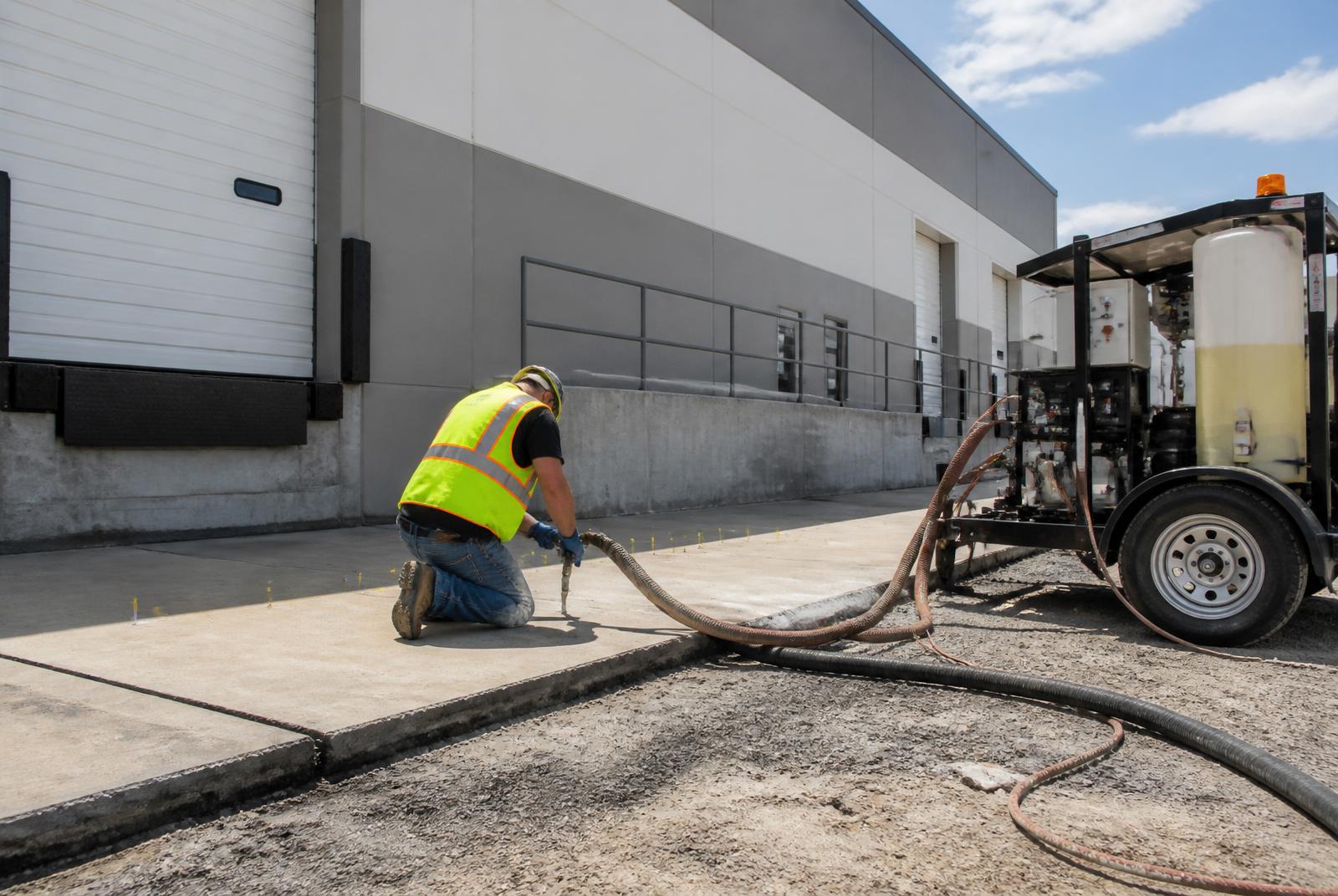
The contractor drills quarter-sized (or larger — often 1–1.5" / golf-ball-sized) holes through the slab and pumps a wet slurry of cement, sand, and water beneath it. The pressure lifts the concrete; the slurry cures over the following days.
It works. It's been used to lift buildings, sidewalks, and highways for the better part of a century. The tradeoffs are weight, cure time, port size, and what happens to the slurry over time in wet soil.
Polyurethane Foam
Two-part expanding closed-cell foam injected through dime-sized ports.
A two-part polyurethane resin is injected through 5/8" ports. The chemicals react, expand, and cure into a closed-cell foam within about 15 minutes. That expansion is what lifts the slab.
The foam is roughly 4 pounds per cubic foot — a tiny fraction of the weight of mudjacking slurry — and it doesn't absorb water, so it won't wash out or lose volume in a wet subgrade.
Pros and cons
Honest tradeoffs for each option.
Mudjacking
Pros
- Long track record on large-scale civil projects.
- Materials are simple and locally sourced.
- Well-suited to lifting extremely heavy commercial slabs where added weight isn't a concern.
- Often the lower per-square-foot material cost.
Cons
- Adds significant weight to the same soil that already couldn't support the slab.
- Slurry can absorb water and erode over time in wet climates.
- 1–2" injection ports leave visible patches.
- Cure time keeps the slab out of service for a day or more at full load.
Polyurethane Foam
Pros
- Cures in ~15 minutes — same-day use.
- Closed-cell foam is waterproof; doesn't wash out.
- Injection ports are dime-sized, not golf-ball sized.
- Adds about 4 lbs per cubic foot vs. 100+ lbs for mud slurry — won't re-settle weak soil.
- Fills voids more completely because it expands into every crack.
Cons
- Typically a higher up-front cost per lift for very small jobs.
- Requires a specialized rig and trained operator — fewer local providers.
Side by side
Cost, time, lifespan, warranty — one table.
Ranges reflect typical Spokane residential projects. Every real number comes from an on-site walkthrough.
| Factor | Mudjacking | Polyurethane Foam |
|---|---|---|
| Cost (typical Spokane residential) | $500 – $1,800 | $700 – $2,500 |
| Time on site | 2–5 hours | 1–3 hours |
| Disruption | Large ports, day of downtime | Small ports, back in service in minutes |
| Expected lifespan | 5–10 years typical in wet soil | 20+ years when drainage is addressed |
| Warranty | 1–5 years, contractor-dependent | Typically 5–10 years |
| Maintenance | Patched ports may re-crack; watch for re-settlement | Occasional joint seal, drainage check |
| Environmental impact | Cement-based; higher embodied carbon | Chemistry-based; no demolition, less material by weight |
| Best application | Heavy commercial slabs, non-critical areas | Residential drives, sidewalks, patios, garage floors |
Spokane climate & soil
Freeze/thaw, clay soils, and drainage.
Spokane soils hold water. That's the single biggest reason polyurethane foam has largely replaced mudjacking here — closed-cell foam is unaffected by moisture, while mud slurry can slowly erode and add weight to already-soft ground.
Freeze/thaw cycles are hard on any patched port. The 5/8" foam port is easier to seal cleanly and less likely to crack around the patch than a 1.5" mudjacking hole.
Environmental impact
Which option is easier on the environment?
Mudjacking uses cement, which carries meaningful embodied carbon per pound. Polyurethane foam uses far less material by weight for the same lift and produces no demolition debris. Neither approach is 'green' in an absolute sense; foam is meaningfully less carbon-intensive per project.
Best use cases
When each option genuinely fits.
Best for Mudjacking
- Very large commercial slabs where added weight isn't a structural concern.
- Situations with unlimited access from above and no landscaping to protect.
- Contexts where cure-time downtime isn't a factor.
Best for Polyurethane Foam
- Residential driveways, sidewalks, and patios in the Inland Northwest.
- Garage floors and pool decks where cosmetics and quick return-to-service matter.
- Slabs over wet or unstable soils that would settle again under mudjacking weight.
- Any project where drainage is part of the problem.
When concrete leveling is the better call
Signals that lifting wins.
- You want the fastest possible return to service.
- The subgrade is wet, soft, or holds water seasonally.
- Visible port patches on the finished surface would bother you.
- You want the lift to still be there in 15+ years.
Not sure which one fits your slab?
We'll give you an honest recommendation.
We come out, walk the slab, and tell you which method (or replacement) is the right buy — even when it isn't a job for us.
When replacement is honestly better
The cases where lifting isn't the right call.
- The slab is crumbling apart, not just settled.
- Structural cracks run through the concrete, not just cosmetic ones.
- You'd rather rebuild the base and re-pour than lift.
Frequently asked questions
Straight answers from Spokane homeowners.
- Is mudjacking cheaper than polyurethane foam?
- Often, but not always — for very small residential jobs the difference is usually a few hundred dollars, and foam's longer lifespan and faster return-to-service typically make up the gap. On large commercial jobs, mudjacking can be materially cheaper.
- Does mudjacking wash out?
- The cured slurry doesn't dissolve, but in wet subgrades the material and the soil beneath it can erode together, which is why you often see mudjacked slabs settle again in 5–10 years in the Inland Northwest.
- Are the holes really that different?
- Yes. Mudjacking ports are typically 1–1.5" — think golf ball. Foam ports are 5/8" — closer to a dime. On a decorative patio or driveway the difference is very visible.
- How long before I can drive on it?
- Foam: usually within an hour or two. Mudjacking: many contractors want the slurry to set up overnight before full vehicle loads.
- Does foam expand and crack the concrete?
- No — a trained operator monitors lift in real time and stops as soon as the slab reaches grade. Expansion pressure is controlled and far below the compressive strength of a healthy slab.
- Which method has a better warranty?
- Foam warranties in this market typically run 5–10 years and often transfer to a new homeowner. Mudjacking warranties are shorter and vary widely.
- Is polyurethane foam safe?
- The cured foam is chemically inert. Cure time is fast, and the material has been used for decades in residential and infrastructure lifting. It's the same material family used in some closed-cell home insulation.
- Which is better for a driveway settling near a downspout?
- Foam, almost always. Water is the driver of that settlement, and foam is water-neutral. See [downspouts and slab settlement](/learning-center/maintenance-tips/downspouts-and-slab-settlement).
Related services
Explore the services this comparison touches.
Keep researching
Related pricing, problem pages, and articles.
Homeowner problems
Serving Spokane and the surrounding Inland Northwest. Prefer to skip the reading? Request a free estimate.
Free estimate — no obligation
Get an honest recommendation for your slab.
Ranges are useful. A real recommendation is better. We come out, evaluate the slab, and tell you which method — or whether replacement — is actually the right buy.
Lift it — don't replace it.
Have questions about your concrete? Need advice? Want a free estimate? We're here to help. Concrete leveling saves the slab you already have, at a fraction of the cost of replacement.
- Often less costly and less disruptive than tear-out and replacement
- Repair before replacement when appropriate
- Modern concrete lifting methods
- Clear recommendations — no pressure, no upsells
Free Estimates · Spokane-Focused Service · Clear Recommendations